Seedance 2.5 Hands-On: 725 Credits Buy 27 Seconds, and the CLI Costs Extra
A ¥69/month membership buys 725 credits — enough for 27 seconds of finished video, about ¥2.5 per second. The Dreamina CLI needs the ¥998/month premium tier, which is where my agent-driven pipeline stopped. Three blockers, one cost calculation done on what I actually paid, and four things wrong with the subtitles.
A cold call from Volcengine got me to spend ¥69 (about $10) on a Seedance membership to test one specific thing: can an agent drive video generation end to end, without me clicking through a web UI?
It could not — and it failed at a point I had not anticipated. This is not a benchmark post. It is a record of three blockers an outsider actually hit, a cost calculation based only on what I paid, and the four things that made the finished clip unpublishable.
Some context for readers outside China: Seedance is ByteDance’s video generation model. Dreamina (Jimeng AI) is the consumer app in front of it, Volcengine is the cloud arm selling the API, and the two are billed on completely different meters — which turns out to matter a lot.
The Call, and What It Gave Away#
I had looked at Seedance 2.0 before and walked away. Access ran through the API, the early entry point involved prepayments in the millions of RMB, and jobs still queued. Complaints about the terms were easy to find. I did not even want to try it.
This call sounded like a different company: plenty of capacity, no queue, rates “as low as ¥0.6 per second”, no prepayment, please go try it. The rep then asked me what I actually needed video generation for.
So I told them exactly what had stopped me before, and that several competitors now look like perfectly good options.
The most informative part of that call was not the price — it was that they have started feeling competitive pressure. MiniMax H3 shipped, and Kling and Wan 3 keep getting better. A few months ago choosing an AI video model meant picking between one or two vendors. Now there is a real market.
Two Things I Care About#
Not leaderboard scores. As an individual user I care about exactly two things:
- Is there a CLI an agent can call, so I can wire it into an automated pipeline?
- Is the unit cost survivable for regular personal use?
Dreamina advertised a CLI that agents can drive. That is the only reason I got hands-on. So: ¥69/month, 725 credits.
Three Blockers — Two I Cleared, One I Could Not#
My setup is a local video-production CLI plus a KiroCrew agent. Nothing about the install went smoothly.
Blocker one: curl -s ... | bash was refused. My own security policy does not allow piping a remote script into a shell. Downloading the script, reading what it does, then running it separately cleared it. Fair enough — my machine, my rule.
Blocker two: no Bun. The repo’s skill-sync script needs the Bun runtime; bash: bun: command not found exited 127. brew install bun (1.3.14) fixed it.
Blocker three was a wall. The Dreamina CLI installed fine, dreamina --version worked, login succeeded, and 725 credits were sitting in the account. Then the first generation job came back from the server:
This account has no dreamina_cli permission: premium membership or above only
That is when I learned that credits and CLI access are two separate entitlements. The ¥69 tier grants credits, not API-style automation. Premium is ¥998/month — around $140.
The pipeline I came to build ended there. Everything after this happened in the web UI, shot by shot, by hand.
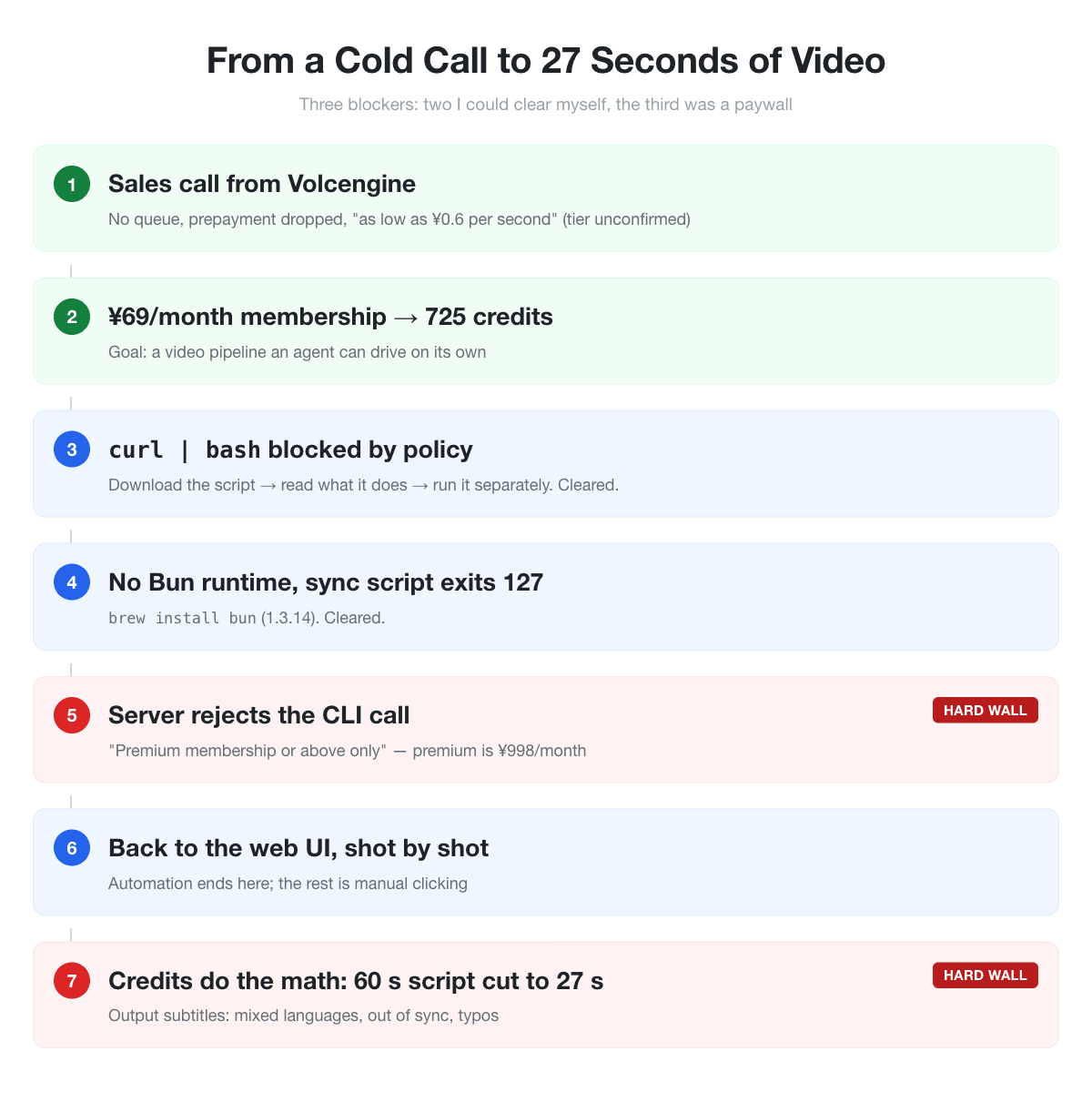
Figure 1: the first two blockers were mine to fix. The third was a paywall, and it decided whether this pipeline could be automated at all.
The Script: I Asked ChatGPT for the Hottest Meme It Knew#
I have no instinct for short-video topics, so I asked ChatGPT to pick whatever meme the internet was currently obsessed with and turn it into a one-minute storyboard.
It came back with Brainrot — roughly, “watching so much absurd short-form video that your brain is polluted, and being unable to stop.” The subject did not matter to me; I only needed something to run through the pipeline.
The storyboard was titled “I Let an AI Agent Run a Company — Every Employee Is an Animal”: a cat CEO, a raccoon engineer, a capybara PM, a duck designer, a husky in marketing, a sloth intern. I had it generate the character sheets and the office set too.
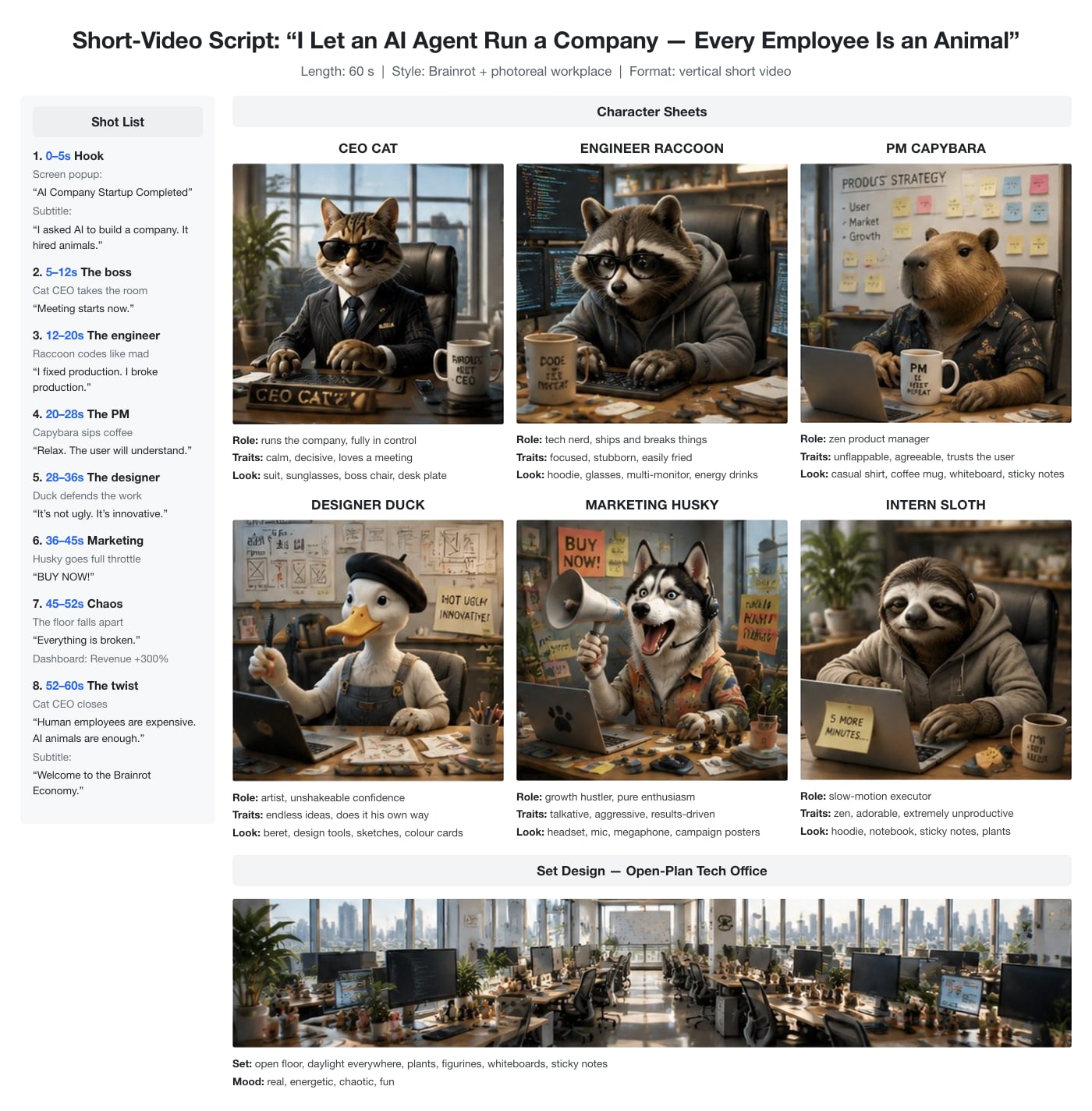
Figure 2: the character sheets were the best output of the entire run. Everything downstream is where it went wrong.
Doing the Math: a 60-Second Script Cut to 27#
The storyboard was 60 seconds across eight shots. I divided 725 credits by the per-second cost and got a ceiling of 27 seconds.
So the script got rewritten to 27 seconds: six shots compressed into a little over five, 3 seconds for the hook, 4 for the closing twist.
One number stopped me: 725 credits burned down to 27 seconds of video works out to about ¥2.5 per second — roughly $0.35.
The sales call had mentioned ¥0.6/second. I decided the two numbers do not belong in the same sentence: the quoted rate is most likely a different Seedance version or tier, billed on the API meter rather than on membership credits. So I do not treat it as a conclusion, only as background — API rates really are coming down.
There is only one figure that means anything for my own decision: I paid ¥69, I got 27 seconds, and those 27 seconds were not in a publishable state.
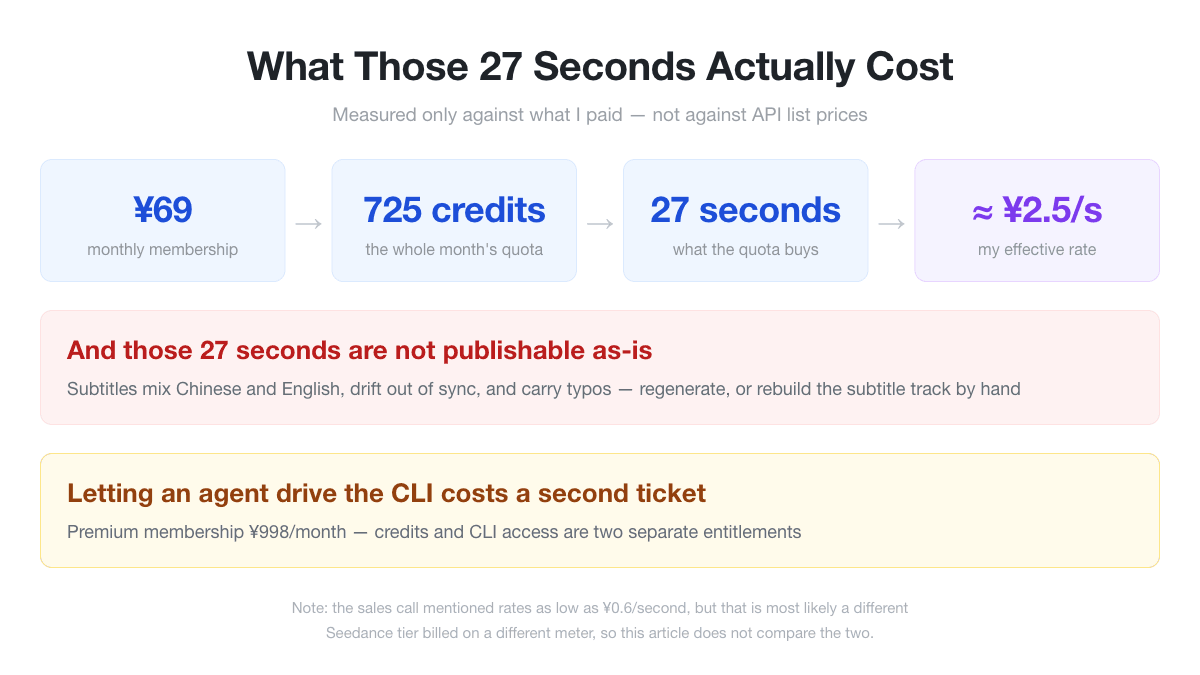
Figure 3: what makes a credit subscription a bad deal for an individual is not the rate — it is that unused quota does not roll over, while used-up quota still is not enough to finish one clip.
The Output: Great Frames, Broken Subtitles#
I handed Seedance 2.5 the two reference images — character sheets plus the office set — and the prompts. The video came out, and the imagery genuinely beat my expectations. Lighting, materials, the animals’ expressions: that photoreal quality people talk about is real.
The subtitles were another matter. Four distinct problems:
- Mixed languages — Chinese and English inside a single line
- Desynchronised — the subtitle describes something other than what is on screen
- Prompt leakage — descriptions I wrote in the prompt got rendered into the frame as on-screen copy
- Obvious typos
Individually survivable. Together, not publishable. Either regenerate, or rebuild the entire subtitle track in post.
You can watch the result here: the finished 27-second clip.
The Real Cost Is the Retry Rate#
To be clear about my starting point: I am an outsider to video production. I did not tune the dialogue, the shot design or the prop art. I wanted to feel out the edges of the tool and see whether it works as a day-to-day video generator for one person.
Three conclusions:
One: the cost is high for me. Not because of the per-second rate, but because a month’s quota does not buy one finished piece. ¥69 for 27 unpublishable seconds.
Two: the retry rate is where the money actually goes. At my skill level the subtitles alone need redoing, and one generation is never enough. Credits are consumed per run, so a few rounds of rework eat the month. The expensive part is not ¥2.5 per second — it is not knowing how many attempts it will take.
Three: the CLI gate closes off automation. ¥998/month to let an agent call it does not work for a hobbyist. The pipeline idea goes back on the shelf.
If You Want to Try It, Check These First#
Working backwards from what I hit, four questions worth answering before you pay:
- Which membership tier includes CLI access? Do not assume credits imply automation. That was my biggest misread.
- How many seconds does your quota convert to? Divide before you write. Do not finish a 60-second script and then discover you can afford 27 seconds.
- What is your plan for subtitles? If you intend to let the model render on-screen text, budget for two or three rounds of rework.
- Does unused quota roll over? Monthly credit bundles are least friendly to exactly the low-frequency user they are priced for.
As for which vendor to bet on, I have relaxed about that question. MiniMax H3, Kling and Wan 3 are all climbing, and Volcengine’s sales team is now making outbound calls — a market shifting from “please let me in” to “tell us what you need.”
For an individual, the rational move right now is probably not to commit to one vendor, but to wait for one more round of the barrier coming down. Call my ¥69 a site survey.
There is a second bill after generation. This piece prices the generating; if you are going to publish the result, the video bitrate calculator estimates file size and delivery bandwidth from resolution and duration.
References
- Seedance 2.5 — ByteDance Seed
- Dreamina (Jimeng AI) — Dreamina
- Volcengine — Volcengine
- Bun runtime — Bun
- The finished 27-second clip — YouTube
Frequently asked
How much video do 725 credits actually produce?
Can the ¥69 membership drive the Dreamina CLI from an agent?
How good is Seedance 2.5 output?
Why does your ¥2.5/second differ from the ¥0.6/second the sales rep quoted?
Is it worth buying in as an individual right now?
Read next
- AI & Agent
How to Build AI Agents for Ad Creative Generation
Automate ad copywriting, image, and video production with Strands Agents and Amazon Bedrock. A practical, code-first guide.
- AI & Agent
How Do I Explain "Agent" to My Wife?
From 'the Lark bot can't do math' to 'raising your own AI lobster' — an AI-agent explainer for normal humans. Thirteen burning questions covering LLMs, tokens, Tools, MCP, RAG, Skills, Memory, Multi-Agent systems, and 2026 model prices. The AI isn't dumb — it just hasn't been raised properly yet.
- AI & Agent
WeChat x OpenClaw: Platform Strategy in the AI Agent Era
WeChat's native OpenClaw integration signals a major shift. Why the world's largest messaging app opening up to AI agents matters.
- Tech Deep Dive
Claude Code vs OpenClaw: 510K vs 530K Lines Source Code Showdown
After Claude Code's source leak exposed 512K lines of TypeScript, we finally get a true apples-to-apples comparison with OpenClaw — architecture, agent definitions, security, and design philosophy.
Get new posts by email
One email when a new article goes up. No ads, unsubscribe in one click.
Your address is used for post notifications only.