OpenClaw vs Claude Code: Architecture and Strategy Compared
Two AI agent products, two radically different philosophies. A deep comparison of architecture, adoption, and what's next.
中文版 / Chinese Version: 本文最初发表于微信公众号。阅读中文原文 →
An Austrian programmer’s weekend project. 310,000 GitHub stars in under four months. A trademark dispute with Anthropic. A crypto hijacking. And an acqui-hire by Sam Altman himself. Meanwhile, Anthropic’s own Claude Code — the buttoned-up corporate sibling — quietly pulls in $2.5 billion in annualized revenue with a fraction of the public attention.
This is the story of two AI agent products that share intellectual DNA but inhabit entirely different universes. And the gap between them reveals something fundamental about what it takes to win in the age of AI agents.
Origin Stories
Claude Code: The Pedigree Play
On February 24, 2025, Anthropic shipped Claude Code alongside the Claude 3.7 Sonnet release. The pitch was straightforward: a command-line AI coding assistant that lives in your terminal, understands your codebase, writes code, runs tests, and manages Git workflows.
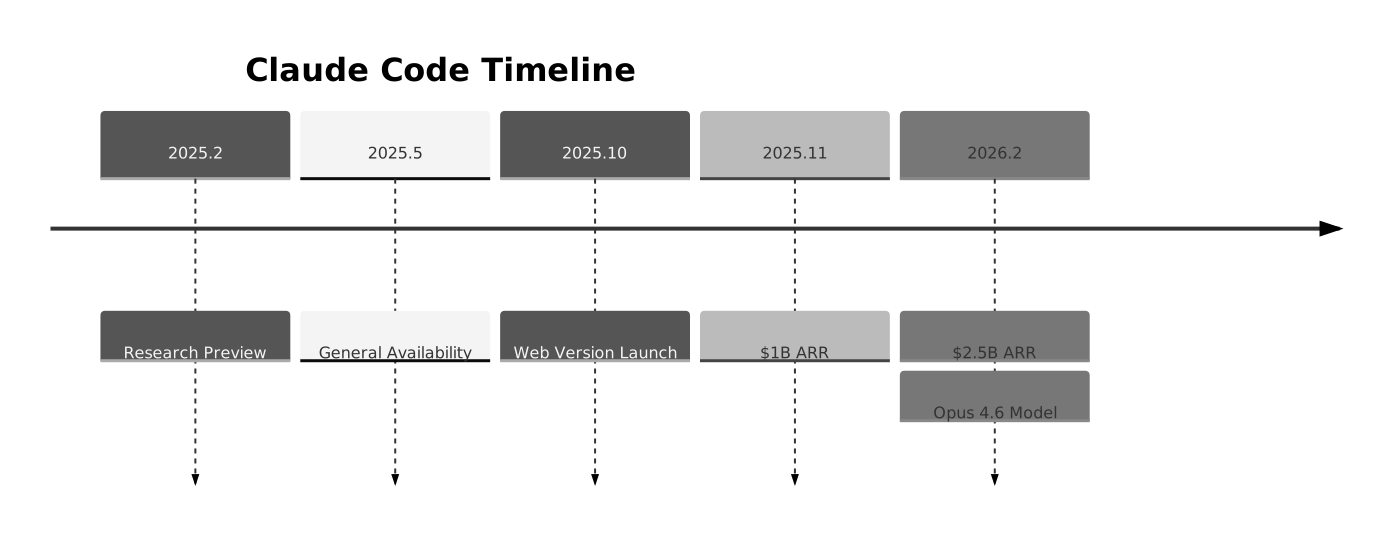
The rollout followed the classic big-company playbook. Research preview first. Public beta next. General availability in May 2025. By November 2025, Claude Code was generating over $1 billion in annualized revenue. By February 2026, that number had climbed to roughly $2.5 billion — a meaningful chunk of Anthropic’s $14 billion overall run rate.
On GitHub, Claude Code accumulated 78,000 stars, 51 core contributors, and 558 commits. By any normal standard, these are exceptional numbers. The growth trajectory reads like an honors student’s transcript: steady, predictable, every milestone right on schedule.
But nobody was talking about Claude Code at dinner parties.
OpenClaw: From Hack to Phenomenon
The other side of this story is considerably more entertaining.
In November 2025, Peter Steinberger — an Austrian developer best known as the founder of PSPDFKit and a veteran of the iOS community — built a small weekend project: a WhatsApp-to-Claude message relay script. He called it Clawdbot. The name was a cheeky play on “Claude,” and he gave it a lobster logo for good measure.
The early code tells the story plainly. Environment variables named CLAWD_URL and CLAWD_TOKEN. A config file called clawd.md. A browser profile folder labeled “clawd managed Brave profile.” The whole thing practically wore a t-shirt that read: I’m a Claude knockoff and I’m not sorry about it.
The project sat quietly on GitHub for two months. Then, in late January 2026, a Hacker News post lit the fuse. Nine thousand stars in twenty-four hours. The numbers kept climbing at an absurd pace: 60,000, then 100,000, then 180,000. By early March it had passed 250,000. As of mid-March 2026, OpenClaw sits at 312,557 stars — surpassing Linux to become the highest-starred non-aggregation software project on GitHub. Mac Minis sold out on multiple e-commerce platforms because people were buying dedicated machines just to run it.
Then Anthropic’s lawyers showed up.
On January 27, 2026, Anthropic filed a trademark complaint: “Clawd” was too similar to “Claude.” Steinberger folded immediately. At 5 AM, he was in a Discord channel brainstorming new names with the community. They first landed on Moltbot — “molt” as in a lobster shedding its shell, a metaphor for growth — but Steinberger thought it sounded awkward. Three days later, OpenClaw was born: keeping the lobster’s “claw,” adding “Open” to signal its open-source nature.
Three names in seventy-two hours. Possibly the fastest triple-rename in open-source history.
The rename created a massive engineering migration burden. Issues ranged from #23757 (“replace outdated legacy names and paths”) to #45404 (“clean up legacy clawd managed Brave profile residue after rename migration”). As of March 2026, the team was still finding remnants in dark corners of the codebase. The repository still contains a CLAUDE.md file — a birthmark that quietly testifies to the project’s lineage.
Here’s the irony: the rename itself became the best marketing the project ever got. “Forced to change its name because it was too similar to Claude” was a story that spread like wildfire through developer communities, pulling in people who had never heard of the project.
But the chaos wasn’t over. During the renaming process, there was approximately a ten-second window during which crypto scammers hijacked the project’s GitHub and X (Twitter) accounts and launched a fake $CLAWD token. It briefly hit a $16 million market cap before crashing to zero.
On February 15, 2026, Sam Altman posted on X: Peter Steinberger was joining OpenAI to lead development of “next-generation personal AI agents.” OpenClaw itself transitioned to an independent open-source foundation.
Weekend project to OpenAI acqui-hire in under ninety days. As Andrej Karpathy put it: “This is the closest thing I’ve seen to a science fiction launch sequence.”
Dissecting the Architectures: Scalpel vs. Arsenal
Strip away the drama and look at the code. What you find are two radically different visions of what an AI agent should be.
Repository Structure Tells the Story
Claude Code is surgically minimal:
claude-code/
├── scripts/        # Installation scripts (Shell: 47%)
├── plugins/        # 14 curated plugins
├── examples/       # Usage examples
└── README.md       # Minimal documentation
Fourteen plugins, each targeting a specific developer workflow: code review, PR review, commit conventions, security guidance, frontend design. This is a precision instrument — not many moving parts, but each one is sharp.
OpenClaw’s src/ directory has over sixty top-level modules:
openclaw/src/
├── agents/          # Multi-agent system
├── browser/         # Browser automation
├── canvas-host/     # Real-time visualization canvas
├── channels/        # 20+ platform adapters
├── gateway/         # Local gateway
├── media/           # Media processing pipeline
├── memory/          # Long-term memory system
├── providers/       # Multi-model provider support
├── tts/             # Text-to-speech
├── plugins/         # Plugin system
├── cron/            # Scheduled tasks
├── pairing/         # Device pairing
├── security/        # Security module
├── i18n/            # Internationalization
└── ...              # 45+ more modules
This is not a tool. This is an entire armory.
Architecture Comparison
| Dimension | Claude Code | OpenClaw |
|---|---|---|
| Core positioning | Terminal AI copilot for developers | Full-platform AI assistant for everyone |
| Interface | Terminal CLI | WhatsApp, Telegram, Slack, Discord, 20+ platforms |
| Tech stack | Shell 47% + Python 29% + TS 18% | TypeScript-first full-stack architecture |
| Architecture | Monolithic CLI tool | Gateway + Channel + Agent microservices |
| Model support | Claude-only (currently Opus 4.6) | Multi-model routing (Claude/GPT/Gemini/DeepSeek/Ollama) |
| Extensibility | 14 curated plugins | Open skill platform ClawHub (5,400+ skills) |
| Deployment | Local CLI install | Local gateway + Docker + mobile companion apps |
| Versioning | Semantic versioning | Calendar versioning (v2026.3.13) |
| State management | Session-scoped, no persistent memory | Persistent Markdown files (SOUL.md / MEMORY.md / IDENTITY.md) |
| License | Proprietary | MIT |
| GitHub Stars | 77,877 | 312,557 |
| Forks | 6,367 | 59,558 |
| Commits | 558 | 19,000+ |
| Revenue model | Paid subscription ($20–$200/mo) | Free & open source; users pay their own API costs ($3–$15/mo) |
Claude Code: Vertical Integration Taken to Its Logical Extreme
Claude Code’s design philosophy boils down to one word: focus.
It’s a CLI tool. You launch it, you enter an interactive session, and the core loop runs like this:
User input → Context assembly (codebase index + CLAUDE.md + conversation history)
  → Claude model inference → Tool calls (file I/O, shell commands, Git ops)
  → Result returned
Claude Code does one thing and does it extraordinarily well: it helps developers write code. It won’t manage your inbox. It won’t book your flights. It won’t clean up your email while you sleep. It’s an extremely powerful programming partner, and it knows where its boundaries are.
Key architectural decisions reinforce this philosophy:
- Single-model binding: Only Claude models (currently Opus 4.6), enabling aggressive prompt optimization and tool-call tuning specific to one model family
- CLAUDE.md configuration: A file that tells the AI about your project — build commands, code style, conventions. Simple and effective
- Sub-agent architecture: Isolated child agents so your database agent doesn’t get polluted by your frontend agent’s CSS context
- Session-scoped context: Each conversation is independent; no cross-session memory
- 558 commits, 51 contributors: Discipline bordering on asceticism
If Claude Code is a philosophy, it’s “do one thing well.” The Unix way, applied to AI agents.
OpenClaw: An Operating System for AI Agents
OpenClaw’s ambition operates on a different scale entirely. It’s not a tool — it’s closer to an agent operating system. With 19,000+ commits and 59,000+ forks, this is a project that has taken on a life of its own.

The architecture follows a layered design:
[Messaging Platform] → [Channel Adapter] → [Gateway Control Plane] → [Agent Runtime] → [Tool Execution / Model Calls]
       ↑                                                                                         |
       └─────────────────────── [Streaming Response] ←──────────────────────────────────────────┘
Gateway Control Plane (src/gateway/): The central nervous system. It listens on ws://127.0.0.1:18789 and everything connects to it — channel adapters, CLI tools, the web UI, iOS and Android companion apps. WebSocket and HTTP control, unified ingestion, health checks, and a webhook API.
Channel Adapters (src/channels/): This is the architectural decision that made OpenClaw go viral. It abstracts WhatsApp, Telegram, Discord, Slack, Signal, iMessage, Google Chat, Microsoft Teams, and more into a unified channel interface. Each adapter handles authentication, inbound message parsing, access control, and outbound message formatting.
Agent Runtime (src/agents/): Model selection, auth key rotation across providers, context window management, tool invocation, security policy enforcement, and streaming output.
Persistent Memory (src/memory/): Perhaps the starkest contrast with Claude Code. OpenClaw stores memory in Markdown files:
SOUL.md— The agent’s “soul”: personality and behavioral principlesMEMORY.md— Long-term memoryIDENTITY.md— Identity informationHEARTBEAT.md— Heartbeat and status
Backed by SQLite-vec for vector search, this enables cross-device, cross-session memory continuity.
Plugin Ecosystem (src/plugins/ + extensions/): The open skill platform ClawHub hosts 5,400+ community-built skills (the awesome-openclaw-skills repo alone has 37,000 stars), spanning programming, marketing, communication, productivity, and Git workflows. The flip side: over 1,184 malicious skills have been discovered, with 341 confirmed as part of a coordinated ClawHavoc attack campaign.
And there’s more: text-to-speech, scheduled task execution, device pairing, internationalization, a real-time visualization canvas, a media processing pipeline. OpenClaw ships on calendar versioning (v2026.3.13) and iterates at a pace that would give most release managers anxiety.
The Philosophical Divide
If you had to distill the difference into a single contrast:
Claude Code says: “I’ll help you write better code.”
OpenClaw says: “I’ll do things for you.”
Claude Code is an augmentation tool. It makes developers more powerful, but the developer stays in the driver’s seat. The boundaries are clear: code-related work is in scope; everything else is out.
OpenClaw is an autonomous agent. It doesn’t just respond to your commands — it acts on its own initiative. Morning briefings, automatic inbox cleanup, scheduled tasks, booking flights, even ordering groceries. The design goal is a “digital twin” that operates on your behalf.
This philosophical gap shows up cleanly in the code:
- Claude Code’s
CLAUDE.mdis a configuration file — it tells the AI what your project looks like - OpenClaw’s
SOUL.mdis a personality definition — it tells the AI who it is
One is tool thinking. The other is entity thinking.
Why OpenClaw Went Viral and Claude Code Didn’t
Claude Code generates approximately $2.5 billion in annualized revenue. OpenClaw is free. From a business perspective, Claude Code is winning by a landslide. But from a cultural perspective — from the standpoint of “what are people actually talking about” — OpenClaw is the phenomenon. Here’s why.
1. The Entry Point Determines the Audience
Claude Code lives in the terminal. The terminal is developer territory. There are roughly 30 million developers worldwide, and perhaps fewer than half are comfortable with command-line interfaces. From day one, Claude Code locked itself inside an elite enclosure.
OpenClaw lives in WhatsApp. WhatsApp has 2 billion users. Telegram has 900 million. Discord has 200 million. When your AI assistant shows up inside the chat app you already use every day — rather than a black-and-white terminal window — the adoption barrier drops to zero.
The situation in China is even more striking. Tencent launched QClaw, an OpenClaw derivative integrated directly into WeChat. Wired reported scenes of elderly Chinese citizens lining up to install OpenClaw on their phones.
A product’s ability to break out of its niche is fundamentally determined by where its front door is. The terminal is a castle drawbridge. A messaging app is a convenience store on a busy street.
2. “Doing Things” Resonates More Than “Writing Code”
Claude Code can refactor a React component. It can craft a perfect Git commit message. That’s impressive — but only to people who know what a React component is.
OpenClaw can reply to emails, organize your calendar, order food delivery, and check flight status. These are things everyone does.
When your mother asks “what can that AI thing actually do for me?”, “it can automatically reply to your messages, organize your photos, and remind you to take your medication” is approximately ten thousand times more persuasive than “it can migrate your Python 2 codebase to Python 3.”
OpenClaw’s tagline is “an AI that actually does things.” Not “an AI that writes code” — just “does things.” That positioning is inherently universal.
3. A Lobster Is More Shareable Than a Terminal
OpenClaw has a lobster mascot. The rename saga was a ready-made viral narrative: trademark dispute with a major corporation, three name changes in seventy-two hours, a crypto scam interlude, and a dramatic acquisition by OpenAI. This story is more entertaining than most Netflix series.
Claude Code’s narrative material? “We released a new CLI tool.” “Our annualized revenue hit $1 billion.” These are business news headlines, not social media fodder.
Technical products don’t spread on the strength of their technology. They spread on the strength of their stories. OpenClaw had a Hollywood-grade narrative arc. Claude Code had a strong earnings report.
4. Local Execution Creates a Sense of Ownership
Claude Code’s compute runs on Anthropic’s servers. OpenClaw runs on your own machine — your Mac Mini, your Raspberry Pi, your home server.
This distinction sounds minor but it’s psychologically enormous. When an AI agent runs on hardware you own, it feels like your AI. Not a service you’re renting from a corporation. It’s your digital assistant, living in your house, working for you around the clock.
That sense of ownership is something SaaS products can never replicate. It’s the difference between having a pet and using a vending machine — one creates an emotional bond, the other is purely transactional.
5. The Open-Source Flywheel
OpenClaw has been MIT-licensed from day one. Anyone can fork it, modify it, commercialize it. The community has contributed 5,400+ skills. Someone built Moltbook — a social network where only AI agents can post, with 15,000 agents posting, commenting, and arguing while humans can only watch. People run OpenClaw on Raspberry Pis. Companies use it to manage entire customer service operations.
Claude Code eventually open-sourced its repository, but under a proprietary license (not MIT or Apache). Its ecosystem follows a “company-led, community-supported” model. OpenClaw’s ecosystem is “community-led, founder-keeping-up” — 59,000 forks versus Claude Code’s 6,000 tells the story of a full order-of-magnitude difference in community engagement.
Open source isn’t just about making code public. It’s a power structure. OpenClaw handed power to its community, and the community repaid it with 310,000 stars.
What This Means for the AI Agent Era
OpenClaw’s explosion isn’t random. It marks an inflection point in AI’s evolution: AI is shifting from conversation to action.
From Chatbots to Agents: A Paradigm Shift
For the past three years, our primary interaction model with AI has been chat. You ask a question, you get an answer. ChatGPT, Claude, Gemini — at their core, they’re all chatbots.
OpenClaw represents the next paradigm: agents. Agents don’t just answer questions. They plan autonomously, execute tasks, and run continuously. You don’t need to babysit them. They operate in the background, handle your affairs, and message you when they’re done.
The significance of this transition is comparable to the leap from search engines to intelligent assistants.
Three Things Worth Thinking About
First, AI agents will enter daily life faster than most people expect.
OpenClaw’s adoption in China has already demonstrated this. When Tencent integrates it into WeChat, when elderly citizens are lining up to install it, this is no longer a tech enthusiast’s toy. 2026 may be the year that “everyone has a personal AI agent” stops being a prediction and becomes a description of reality.
Second, privacy and security deserve serious attention.
Alongside OpenClaw’s viral growth, security researchers have uncovered widespread misconfiguration: exposed API keys, remotely accessible shells, emails that can be exfiltrated within five minutes. An AI agent with access to all your apps, if improperly configured, is an open back door. SecurityScorecard found over 135,000 OpenClaw instances running with insecure default configurations exposed to the public internet.
Don’t let “free” and “useful” override basic caution. Any AI that can act on your behalf means you’ve handed it the keys. Make sure you know exactly what it can and cannot access.
Third, the real skill is learning to collaborate with AI — not just delegate to it.
Claude Code and OpenClaw embody two distinct models of human-AI collaboration:
- The Claude Code model: AI as your tool. You direct, it executes, you make the decisions.
- The OpenClaw model: AI as your agent. You authorize, it acts autonomously, you supervise.
Both models have value. The key is finding the right balance for your situation. Ignoring AI entirely means falling behind. Delegating everything to AI means losing your own judgment. The optimal state is straightforward: you understand what AI can do, and you decide what to let it do.
The Bottom Line
Claude Code is an elite’s blade. OpenClaw is everybody’s Swiss Army knife. One is quietly making billions. The other is noisily reshaping how the world thinks about AI.
Their stories converge on a single insight: a technology’s impact isn’t determined by how advanced it is, but by how many people it can reach.
A lobster managed to upend Silicon Valley not because its code was better than Anthropic’s, but because it found a path to every person’s phone.
And in the age of AI agents, that’s the only thing that really matters.
Sources: This analysis draws from GitHub repositories (anthropics/claude-code, openclaw/openclaw), Wikipedia — OpenClaw, Wired, LearnDevRel, Paolo’s OpenClaw architecture overview, and Moely’s source code review. Data as of March 15, 2026: Claude Code 77,877 stars; OpenClaw 312,557 stars.
References
- Claude Code repository — GitHub
- OpenClaw repository — GitHub
- China Is Going All In on OpenClaw — WIRED