WeChat x OpenClaw: Platform Strategy in the AI Agent Era
WeChat's native OpenClaw integration signals a major shift. Why the world's largest messaging app opening up to AI agents matters.
中文版 / Chinese Version: 本文最初发表于微信公众号。阅读中文原文 →
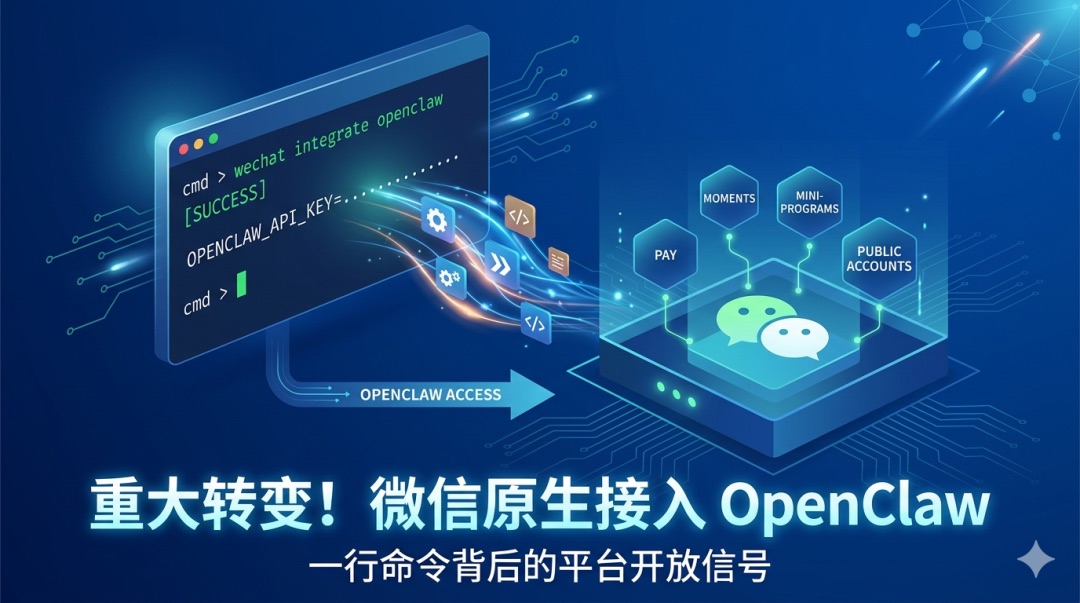
Something quietly remarkable happened this week. Tencent shipped a CLI tool that lets you turn WeChat — the messaging app used by 1.3 billion people every day — into an AI agent interface. One command, one QR code scan, and suddenly the most ubiquitous communication platform in China becomes an OpenClaw frontend.
The command itself is almost comically simple:
npx -y @tencent-weixin/openclaw-weixin-cli installBut what it represents is anything but simple. This is WeChat signaling, in the clearest terms yet, that it is ready to open its platform to the AI agent ecosystem. And if you understand what WeChat is — truly is — in the context of daily life for over a billion people, you will understand why this matters far beyond China.
What WeChat Actually Is
For readers outside China, it is tempting to think of WeChat as “Chinese WhatsApp.” That comparison undersells it by an order of magnitude. WeChat is a super-app: messaging, social media, payments, mini-programs (essentially apps within the app), government services, healthcare bookings, ride-hailing, food delivery, and more. It is the operating system of daily digital life in China in a way that no single Western app has achieved.
With 1.3 billion daily active users, WeChat is not just a messaging app. It is the interface through which a massive portion of humanity conducts both personal and professional life. When you pay for groceries in Shanghai, you scan a WeChat QR code. When your kid’s school sends a notice, it arrives via WeChat. When a business sends you an invoice, it comes through a WeChat mini-program.
This is the platform that just opened its doors to AI agents.
The Setup: Deceptively Simple
The integration works through an official npm package published under the @tencent-weixin namespace. The setup flow is deliberately frictionless:
- Run the CLI command to install the OpenClaw WeChat plugin
- A QR code appears in your terminal — scan it with WeChat to authenticate
- Start chatting with the AI directly inside WeChat
That is it. No separate app to download. No new account to create. No workflow to learn. The AI meets you where you already are, inside the app you already have open. The plugin even supports multi-account login, meaning developers and teams can manage multiple WeChat-connected AI agents simultaneously.
Once connected, the capabilities are substantial: conversational AI, real-time web search, code generation and debugging, document management, multi-platform message synchronization, scheduled (cron) tasks, browser automation, and sub-agent collaboration. It is not a chatbot bolted onto a messaging app — it is a full AI agent runtime wired into the platform’s communication layer.
The only requirements are WeChat version 8.0.70 or above and a restart after updating. The barrier to entry is, for all practical purposes, zero.
Why This Matters: The Last Mile Problem
There is a structural problem in the AI industry right now that nobody talks about enough: distribution.
Every major AI lab can build impressive models. Every tech company can ship a chat interface. But getting AI into the daily workflow of a billion non-technical users — that is the hard part. It is the “last mile” problem of AI adoption, and it is overwhelmingly a distribution problem, not a technology problem.
Consider the current landscape. If you want to use ChatGPT, you download the ChatGPT app or visit the website. If you want Claude, same thing. Each AI product asks users to come to it — to adopt a new interface, form a new habit, remember a new URL. This works for early adopters and power users. It does not work for the 60-year-old shopkeeper in Chengdu who has never installed an app that was not already on their phone.
WeChat is already on their phone. WeChat is already open. WeChat is where they already are, all day, every day.
By allowing AI agents to operate natively inside WeChat, Tencent is solving the last mile problem in the most elegant way possible: the AI comes to the user, not the other way around. There is no adoption friction because there is nothing to adopt. The user simply starts a conversation — the same thing they do hundreds of times a day already.
The Openness Signal
Perhaps more significant than the integration itself is how it was shipped. This is an official npm package under the @tencent-weixin namespace — Tencent’s own verified publishing identity. This is not a third-party hack, not a reverse-engineered API, not a tolerated workaround. This is Tencent deliberately, officially, and publicly opening WeChat to AI agents.
For anyone who has followed WeChat’s history, this is extraordinary. WeChat has been famously, aggressively closed. Its walled garden approach has been a defining characteristic — and a source of persistent criticism — for over a decade. The platform has historically guarded its ecosystem with the jealousy of a dragon guarding gold.
So what changed?
The Strategic Calculus
The answer lies in competitive pressure that makes openness not just attractive, but existential.
Look at what is happening globally. Apple is weaving Siri and Apple Intelligence into every layer of iOS — your AI assistant lives inside your operating system, your messages, your email, your photos. Google is doing the same with Gemini across Android and its productivity suite. In China, ByteDance is integrating its Doubao AI model into Douyin (the Chinese TikTok), creating an AI-native content and communication experience for its 700 million daily users.
Every major platform is racing to become the default AI interface for its users. The logic is simple: if your platform is not the surface through which users interact with AI, users will eventually migrate to platforms that are. AI is becoming the new interaction layer, and platforms that do not integrate it risk being disintermediated.
WeChat’s dilemma was acute. Its greatest asset — that 1.3 billion daily active user base, deeply habituated to the platform — was at risk of becoming a liability if those users started spending their “AI time” elsewhere. A closed WeChat with no AI capabilities would watch as users gradually shift attention to platforms that offer intelligent assistance.
The strategic response is what I would call “trading openness for stickiness.” By opening WeChat to AI agents like OpenClaw, Tencent ensures that users have no reason to leave WeChat to get AI capabilities. The platform becomes more valuable, more sticky, more indispensable — precisely because it opened up.
This is not altruism. This is platform survival strategy executed with clarity.
For Developers: A New Surface Area
The developer implications are immediate and significant. Before this integration, building AI-powered interactions inside WeChat required navigating a labyrinth of official accounts, mini-program approvals, and restricted APIs. The barrier was high enough that only well-resourced teams could realistically attempt it.
Now, the barrier is a single npm command.
Any developer who can run a terminal can connect an AI agent to WeChat. This is not just a convenience improvement — it is a categorical change in who can build AI experiences for WeChat’s user base. A solo developer, a weekend hackathon team, a startup with no Tencent connections — all of them can now build and deploy AI agents that interact with users through the most widely used messaging platform on Earth.
The capabilities available through this integration are not trivial either. Sub-agent collaboration means developers can compose complex multi-agent workflows. Browser automation means agents can perform web-based tasks on behalf of users. Cron scheduling means agents can operate autonomously on a timetable. This is not a toy — it is a full agent runtime with WeChat as the communication layer.
The Redefinition of “Entry Point”
There is a deeper conceptual shift happening here that extends beyond WeChat and beyond China.
For the past two years, the AI industry has operated on the assumption that AI products need their own dedicated interfaces — their own apps, their own websites, their own brand presence. The implicit model is: build it, and users will come to you.
WeChat’s move suggests a different model entirely: AI should go where users already are.
This is the redefinition of what an “entry point” means in the AI era. The entry point is not the AI app. The entry point is whatever app the user already has open. The AI is the capability; the messaging platform is the interface. The two are decoupled, and the interface wins by virtue of existing habit and distribution.
If this model succeeds — and WeChat’s scale gives it a serious chance — it has implications for every AI company and every platform company. For AI companies, it suggests that distribution partnerships with existing platforms may matter more than building standalone apps. For platform companies, it suggests that openness to AI agents is not a nice-to-have but a strategic imperative.
What to Watch
Several questions remain open. How will Tencent moderate AI agent behavior inside WeChat? What happens when an AI agent sends incorrect information or makes a mistake in a conversation — who is liable? Will Tencent eventually monetize this integration through API fees, revenue sharing, or premium tiers? And how will Chinese regulators, who have been actively governing AI-generated content, respond to AI agents operating inside the country’s dominant messaging platform?
These are not theoretical questions. With 1.3 billion daily active users, any issue will manifest at a scale that demands answers quickly.
But the direction of travel is clear. The walls around WeChat are coming down — selectively, strategically, but unmistakably. And the reason is not that Tencent has suddenly embraced open-source idealism. The reason is that in the AI agent era, closed platforms face a new kind of competitive threat: irrelevance.
WeChat’s bet is that by opening up to AI, it becomes the platform through which AI reaches a billion people. That is not just a product decision. That is a platform strategy for the next decade.
And it all started with one CLI command.
References
- OpenClaw repository — GitHub
- OpenClaw documentation — OpenClaw