Don't Just Buy Your Engineers AI Tools: The Complete Playbook for Becoming an AI-Native Company
Why companies that bought every AI coding tool still aren't shipping faster — and the four-layer playbook that actually works: Loop Engineering for individuals, Harness Engineering for teams, AI-DLC 2.0 and AI-PLC for process, and a full organizational redesign of roles, KPIs, policies, and middle management.

中文版 / Chinese Version: 别只给员工买 AI 工具:互联网公司转型 AI Native 的完整方法论
Loop Engineering · Harness Engineering · AI-DLC 2.0 · AI-PLC · Organizational Redesign
In a previous article (in Chinese) we walked through AWS’s AI-DLC methodology — how to organize software delivery so that AI executes and humans check in at key milestones. The most common follow-up question we received was the same one: “We understand the methodology. We bought the tools, opened the accounts, ran the training. Why isn’t the company as a whole any faster?”
This article is the sequel — and the escalation. It moves from the development process up to the entire organization.
Prologue: You Bought All the Tools. Why Isn’t the Company Faster?
In 2026, nearly every tech company is “all in” on AI.
Buy the most expensive AI coding tools and roll out licenses to everyone. Run workshops on prompting techniques. Issue top-down mandates that everyone must “embrace AI.”
Six months later, the retrospective numbers are awkward: code output is genuinely up, but time-to-ship has barely moved. Requirements still pile up in review meetings, testing still bottlenecks before release, and incidents still mean waking someone up at 3 a.m.
There’s a sharper data point. In 2025, METR ran a randomized controlled trial in which experienced open-source developers worked with AI tools — and came out 19% slower on average, while believing they had been 20% faster. (METR’s early-2026 follow-up acknowledges that with newer tools the slowdown figure no longer holds; but the deeper finding has not been overturned: the gap between how much faster people feel with AI and what the stopwatch actually says can be nearly 40 percentage points.)
So where is the problem?
A metaphor. Strap a jet engine onto a horse-drawn carriage and you don’t get an airplane — you get a carriage shaken to pieces. The AI model is that engine, doubling in capability every few months. But an engine is not a vehicle. You still need a chassis, a transmission, brakes, instruments, and an entirely new set of traffic rules. Most corporate “AI transformations” stop at buying the engine.
This article makes one argument: between “a company that uses AI” and “an AI-Native company” stand four layers of rebuilding —
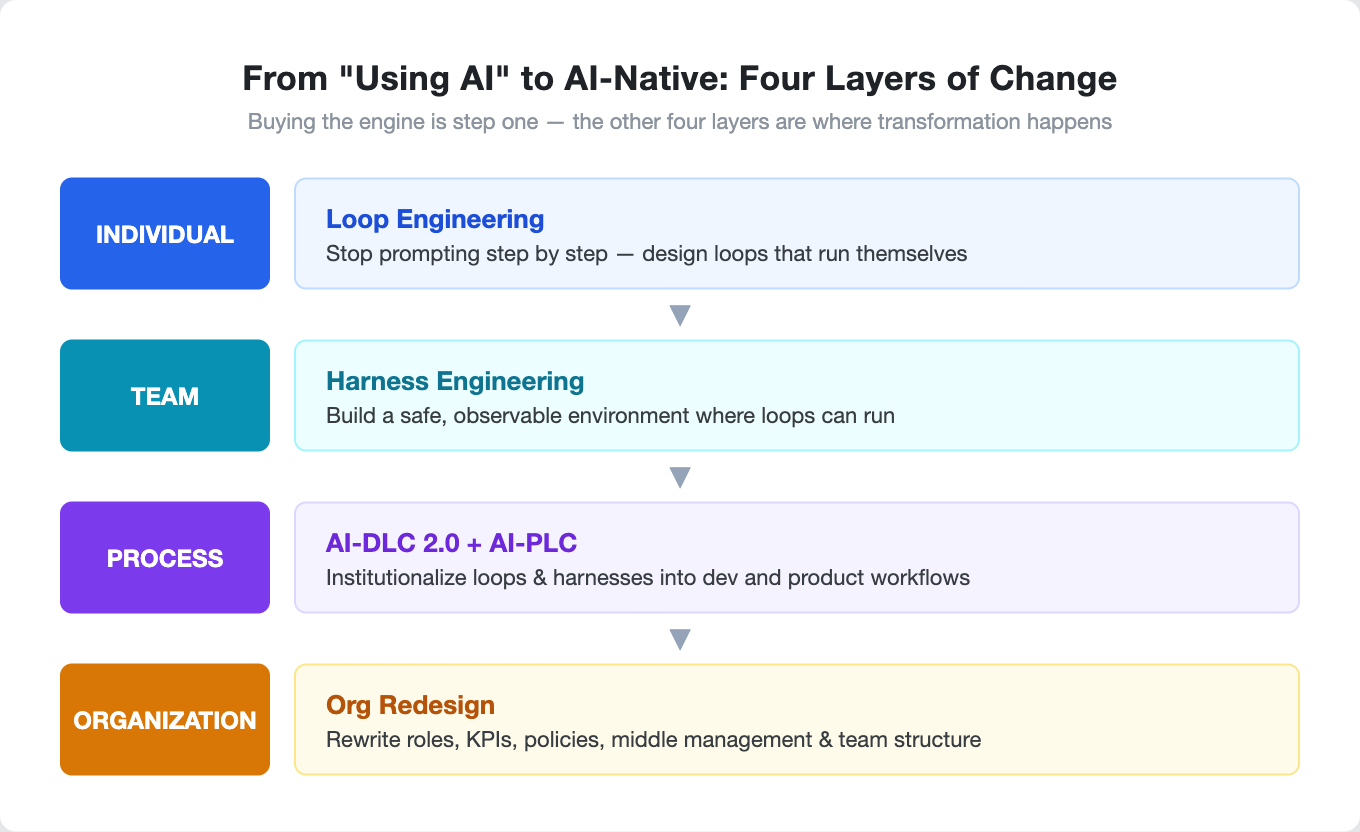
The methodology for these four layers comes from the most important public practices of 2026: OpenAI’s Harness Engineering experiment, the Loop Engineering discipline named by Addy Osmani, and AWS’s open-source AI-DLC 2.0 specification and AI-PLC workflows.
Let’s take them one layer at a time.
Two Landmark Events: The Engine Is Ready
Event one: three people, five months, a million lines of code, zero written by hand.
In 2026, a team inside OpenAI ran an experiment: build an internal version of a software product from scratch, with humans forbidden from writing a single line of code. Application logic, tests, CI configuration, documentation, monitoring, internal tooling — every line generated by Codex, OpenAI’s coding agent.
Five months later the product had internal daily active users and external testers. It shipped, deployed, broke, and got fixed — normally. The team grew from 3 engineers to 7 and merged roughly 1,500 pull requests, about 3.5 per person per day. Their estimate: 90% less time than writing the code by hand.
Their summary is four words: Humans steer. Agents execute.
Event two: two declarations, one new discipline.
Also in 2026, the authors of two of the world’s best agentic tools said two things, back to back.
Peter Steinberger, author of OpenClaw: “You shouldn’t be prompting coding agents anymore. You should be designing the loops that prompt them for you.”
Boris Cherny, author of Claude Code, was blunter: “I don’t prompt Claude anymore.”
Note who these people are: the two humans most skilled at using AI coding tools on the planet — they wrote the tools. Even they have stopped directing AI line by line.
In June, Addy Osmani — engineering lead on Google Chrome — gave the shift its formal name: Loop Engineering. A new discipline was born.
Both events say the same thing: the engine is strong enough, and the bottleneck has moved outside the engine. The question is — what exactly is “outside”?
Loop Engineering: From “Using AI” to “Designing Loops”
Start with a kitchen analogy.
There are two ways to cook rice. One is a wood-fired stove: you stand there watching the flame, adding wood, stirring — you cannot walk away. That is what prompting an AI step by step feels like: every move it makes, you watch, correct, and issue the next instruction.
The other is a rice cooker: add rice and water, press the button, and go do something else. Why can you walk away? Because the rice cooker contains a closed loop — a temperature sensor keeps checking; not done means keep heating; done means switch to keep-warm, automatically.
Loop Engineering is building rice cookers for AI: design a loop that runs by itself and stops by itself when “done” is verified — instead of standing next to the stove issuing instructions.
Here is what a well-designed loop looks like:
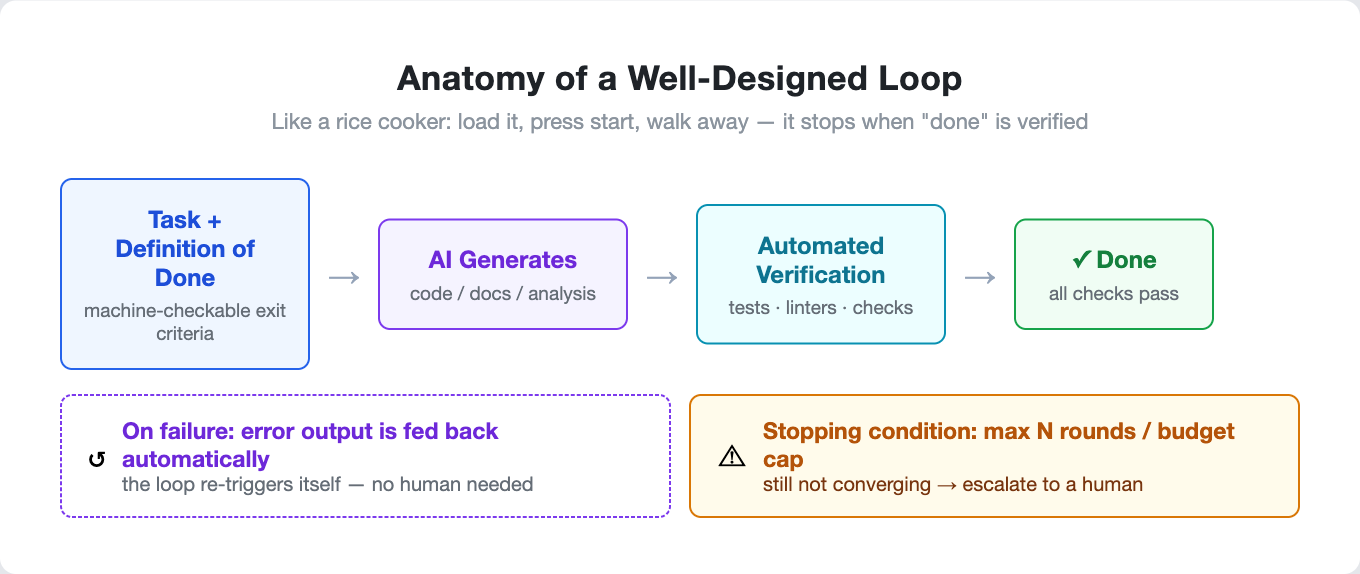
Four elements: what each iteration does, what triggers the next one, what counts as “done”, and what happens when it gets stuck. Of the four, the third is the hardest — and the most important.
“The report is finished” is not a definition of done — the AI will declare it finished on round one. “The report contains an executive summary, three argument chapters, at least two data citations per chapter, and passes a consistency check against the original requirements” — that is a definition of done. The more crisp and checkable your definition of done, the farther the AI can walk on its own.
That is what those two declarations really mean. When Cherny says “I don’t prompt Claude anymore,” he hasn’t stopped using AI — he has moved his effort elsewhere: defining completion criteria, wiring up automatic triggers, setting escalation paths for when things get stuck. The AI then runs inside the loop, and he only handles the exceptions the loop throws.
Osmani identifies six building blocks that support a loop. Don’t memorize the names; the functions are self-explanatory:
- Automations — timers and event triggers, so loops don’t need a human to start them
- Worktrees — parallel isolated workspaces, so multiple loops don’t trample each other
- Skills — “how we do this kind of thing” captured as files the AI can load
- Connectors — access to real systems: databases, logs, ticketing
- Sub-agents — big tasks split across multiple specialized AIs
- External state — progress stored in files rather than chat history, so work survives interruption
For an individual, this inverts the job: your value is no longer “being great at instructing AI” but “designing systems that don’t need your instructions.” One person goes from operating a machine to managing a workshop.
But a loop only solves “the AI keeps itself running.” The moment it runs, new questions appear: what is it allowed to touch? Who notices when it breaks something? Why should anyone trust what comes out?
That is the second layer.
Harness Engineering: Loops Need a World to Live In
A harness is the tack that turns a wild horse into usable horsepower. In the AI context:
The loop defines the AI’s behavior (what to do, when to stop). The harness defines the AI’s environment (what it can touch, what happens on failure, how its work stays visible).
However elegant your loop, it cannot survive without an environment. What happens when a tool call times out? When the context window fills up? When the AI edits a file it shouldn’t? And when your boss asks “what exactly did the AI do last Tuesday” — can you answer?
Back to OpenAI’s million-line experiment. The thing worth copying is not “3 people, 5 months” — it’s the harness they built, in three layers:
Layer one: make the repository the single source of truth (Context Engineering). Everything the AI needs to know — architecture notes, conventions, decision records — lives in the repo, structured and indexable. The AI doesn’t rely on humans verbally explaining background; it reads the repo itself. The corollary: knowledge that lives in someone’s head, in chat history, or in slide decks does not exist as far as the AI is concerned.
Layer two: enforce architectural constraints with machines. They wrote custom linters that turn rules like “module X must not call module Y” into hard checks that run on every commit. The clever part: the error messages are written for the AI — they don’t just say “violation,” they say “here’s what it should look like, and here’s the reference file.” The AI reads the error and fixes itself, no human involved.
Layer three: use AI’s speed to fight AI’s chaos. AI produces code so fast that documentation rot and dead code accumulate faster than humans can clean up. So they run a fleet of “garbage-collection agents”: daily scans for doc/code inconsistencies, weekly sweeps of uncalled dead code — automated entropy reduction to counter automated entropy production.
Mitchell Hashimoto, co-founder of HashiCorp, gives Harness Engineering its plainest definition: every time an agent makes a mistake, engineer a fix so it can never make that mistake again. With humans, we handle mistakes by “criticism and a reminder to be careful next time.” A harness handles mistakes by “reshaping the environment so the mistake is physically impossible.” The former relies on memory; the latter compounds into an asset.
Where Humans Stand: A Four-Step Ladder
Kief Morris of Thoughtworks maps the human-AI relationship as a ladder — it’s also a career roadmap for every technologist over the next few years:
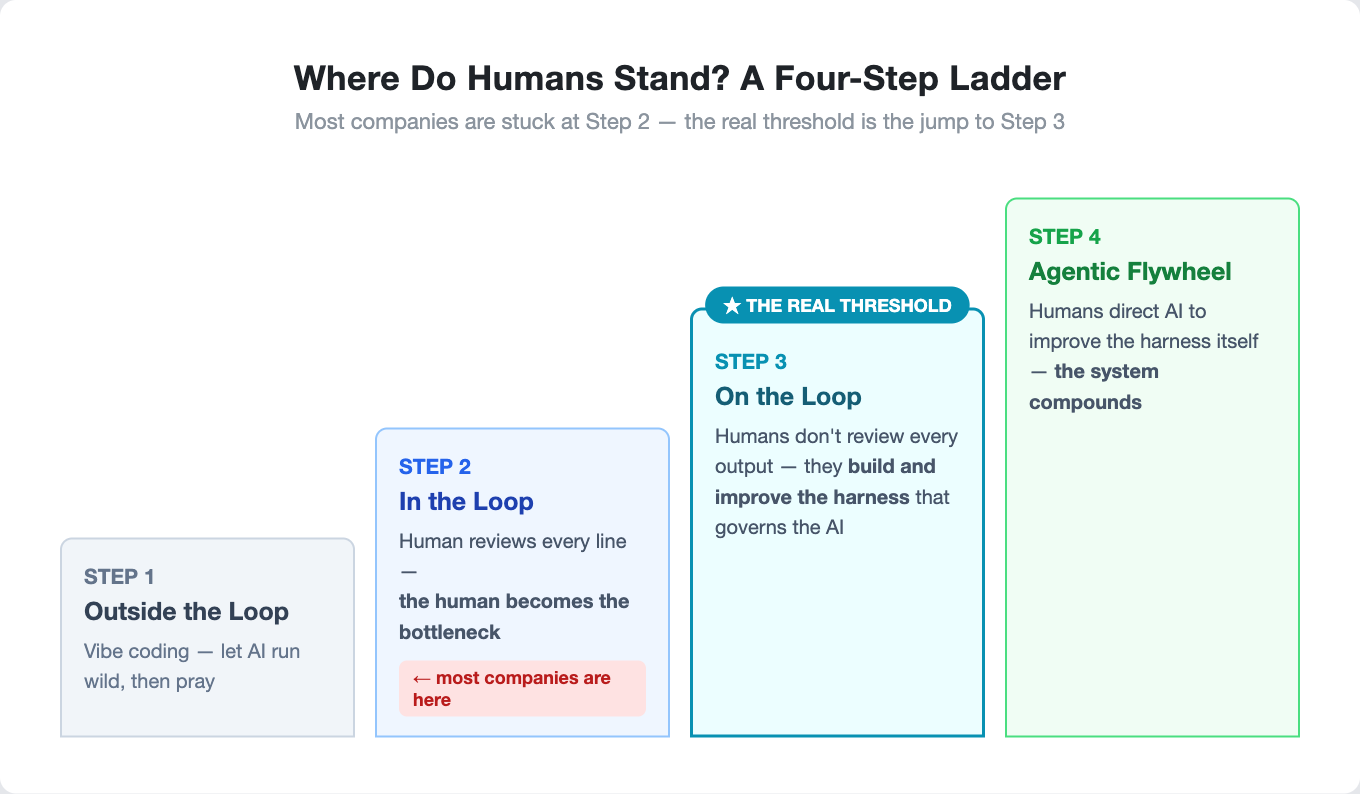
Most companies are stuck at step two: employees use AI, but every output goes through human review, the reviewers become the new bottleneck, and the conclusion becomes “AI doesn’t save time.” The jump from step two to step three is the real threshold of AI-Native transformation — human attention moves from “checking outputs” to “building the system that checks outputs automatically.”
Chad Fowler, a Ruby community elder, places this shift in software-engineering history: when Agile displaced Waterfall, engineering discipline didn’t disappear — it moved from heavyweight documents into automated tests. The same is happening now:
Discipline doesn’t disappear. It moves. This time, from human review into machine verification. The formula: probabilistic on the inside, deterministic at the boundary — let AI improvise within the boundary, but make the boundary strict, explicit, and machine-enforced.
At this point individuals have loops and teams have environments. But a company of hundreds or thousands can’t have every team invent its own wheels. How do you promote Loop and Harness into a company-wide standard process? That is the question AWS’s AI-DLC 2.0 answers.
AI-DLC 2.0: Institutionalizing Loops and Harnesses into a Pipeline
AI-DLC (AI-Driven Development Lifecycle) is AWS’s open-source delivery methodology. Version 1.0 proved one thing: organizing delivery as a sequence of stages where AI executes and humans approve at checkpoints actually works.
This year’s 2.0 specification (public on GitHub at awslabs/aidlc-workflows) is far more ambitious: as the machine-verifiable surface expands, progressively reduce human involvement and converge toward autonomous software delivery.
Here are the five designs in the 2.0 spec most worth borrowing — and note that none of them is only about code. Remember that; in section 6 we’ll use them to rebuild the org chart.
Designs one & two: the three-compartment model + two kinds of validation
The 2.0 spec defines any unit of delivery work in three “compartments”: a generation spec (what comes in, what goes out), a validation spec (how you know the output is right), and a learning spec (what the unit learns at runtime). The validation spec then splits into two kinds — what can be computed goes to machines; what requires taste stays, for now, with humans:
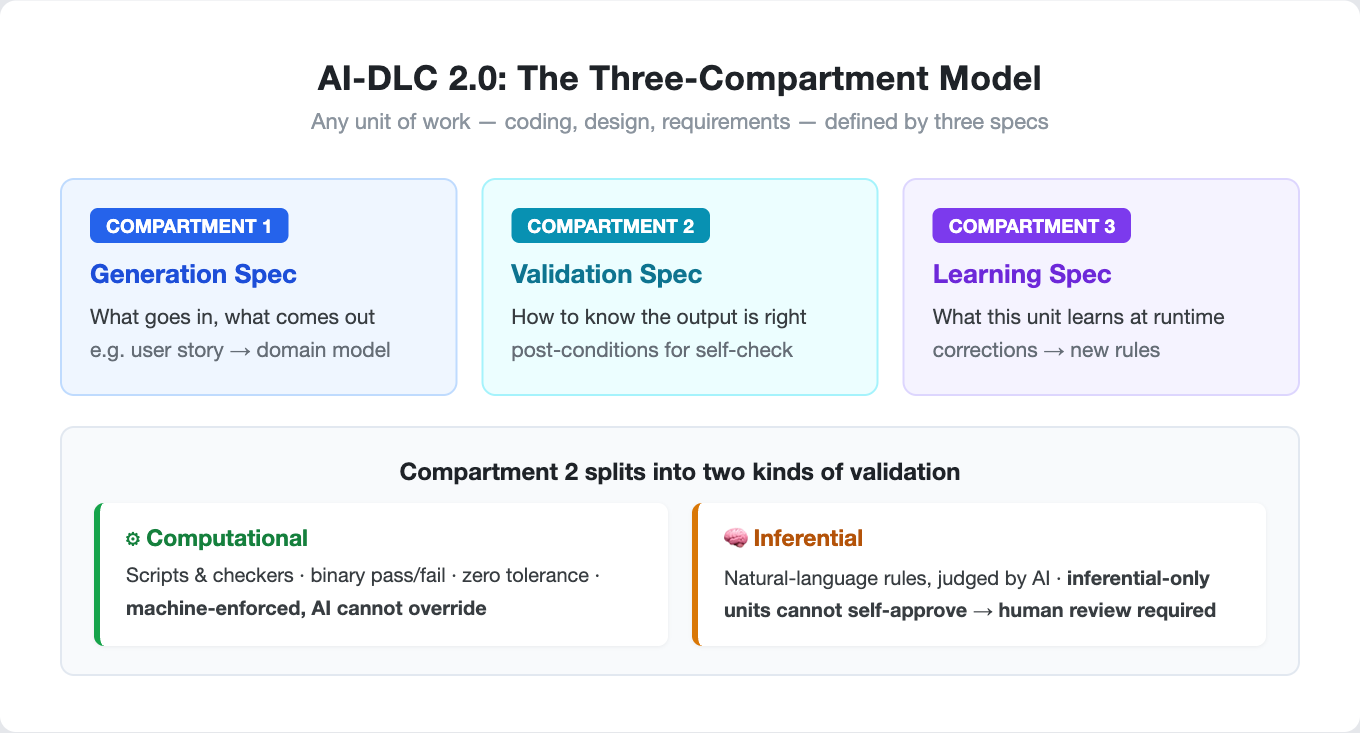
See it? Compartment two is exactly the “definition of done” from Loop Engineering — the whole three-compartment model is a loop, institutionalized. The rice cooker’s shutoff condition, promoted from personal craft to a company-standard component.
And the model doesn’t care what the work is. “Requirements clarification” fits (input: vague ask; output: structured requirements doc; validation: every requirement has a testable acceptance criterion). “Architecture design” fits. “Deployment” fits. Any work whose input, output, and correctness criteria can be stated can be put inside a loop.
The two kinds of validation are a critical distinction. Computational validation is scripts and checkers — binary, zero-tolerance, e.g. “no endpoint ships without authentication” — enforced by machines; the AI doesn’t get a vote and can’t modify them. Inferential validation is natural-language rules judged by AI, e.g. “the code is readable” — quality heuristics, not hard gates.
One soberly brilliant rule in the spec: a unit that has only inferential validation (AI grading itself) cannot self-approve — it must go to human review. This blocks AI’s most insidious failure mode: generate, grade yourself, declare success — satisfying the letter of the check while dodging its intent.
Design three: stopping conditions — brakes are the precondition for autonomy
Every self-correcting loop must carry stopping conditions: a maximum number of iterations, a budget cap. Hit the cap without converging and the loop must stop burning and escalate to a human. One design, two birds: it prevents runaway AI (infinite loops burning money) and prevents humans becoming the bottleneck (approval for everything). The AI is fully autonomous inside the boundary; humans appear only when judgment is genuinely needed.
Design four: Skills — the process becomes Lego bricks
AI-DLC 1.0’s lesson was that a rigid process dies on contact with reality: the spec said “build and test” was one stage, but nearly every customer split it into review, build, functional testing, and security testing; some teams produce UI mocks during story writing, others not until design. The 2.0 fix: stop prescribing monolithic stages and demote the smallest building block to a Skill — a discrete capability unit corresponding to judgment once supplied by a class of expert: database design, code review, security analysis… Each Skill is internally defined by the three-compartment model, and companies compose, replace, and add them freely.
The process turns from one fixed assembly line into a box of freely composable Lego. It is the spec’s honest answer to the reality that every company is different.
Design five: the Orchestrator — the loop above the loops
With many Skills, who conducts? The spec defines an Orchestrator role with five duties. Read them carefully — they return in section 6:
- Goal ownership: accountable for the end-to-end outcome; never delegates goal-tracking to a single stage
- Process composition: assembles the flow dynamically by intent (a greenfield project and a bug fix take different paths); plans are revisable
- Routing & control: feeds each unit the right inputs, tracks state, enforces stopping conditions, manages escalations, keeps a complete audit trail
- Abstraction boundary: treats each unit as a black box — never reaches inside; only verifies outputs against post-conditions
- Cross-cutting invariants: naming conventions, security policies and other rules that span the whole flow are enforced by the orchestrator at key checkpoints
If these five duties read like a job description for a manager — correct. Hold that thought.
AI-PLC: Transformation Is Not an Engineering-Only Show
Sharp readers will have spotted the hole: everything so far is about how things get built. But what to build, and why — still runs the old way. The PM writes a Word PRD, calls review meetings, plays telephone through the layers — and three months later the engineering team uses its state-of-the-art AI pipeline to efficiently ship a feature nobody wants.
If upstream doesn’t change, downstream speed is just idling. That is why AWS open-sourced AI-PLC (AI-Driven Product Life Cycle, the sample-ai-plc project on GitHub): put product managers and business roles inside loops too.
AI-PLC is a pure natural-language conversational workflow — no code required — built for PMs and business owners. It offers three entry points covering different starting states of product thinking:
- Start from customer pain. You have feedback, bad reviews, research material. The AI walks you through distilling pain points, then uses Amazon’s classic Working Backwards method to generate a PR/FAQ — writing launch-day press release and FAQ first, forcing you to answer “why would a customer care.” Then solution analysis and a prototype spec.
- Start from a pile of ideas. The team has 10 or 20 AI use cases and no idea what to do first. The AI files each one, scores them with a prioritization framework, picks the top 3, and generates a
PROTOTYPE-*.mdspec file for each. - Start from a spec file. Hand the AI a PROTOTYPE file generated by another team, skip all the meetings, and have it build the clickable prototype directly.
Two designs deserve attention.
First, the handoff artifact is an executable file, not words passed around a meeting. The interface between product and engineering changes from “meetings + documents + endless alignment” into a contract the AI can execute directly. The product loop’s exit plugs straight into the development loop’s entrance:
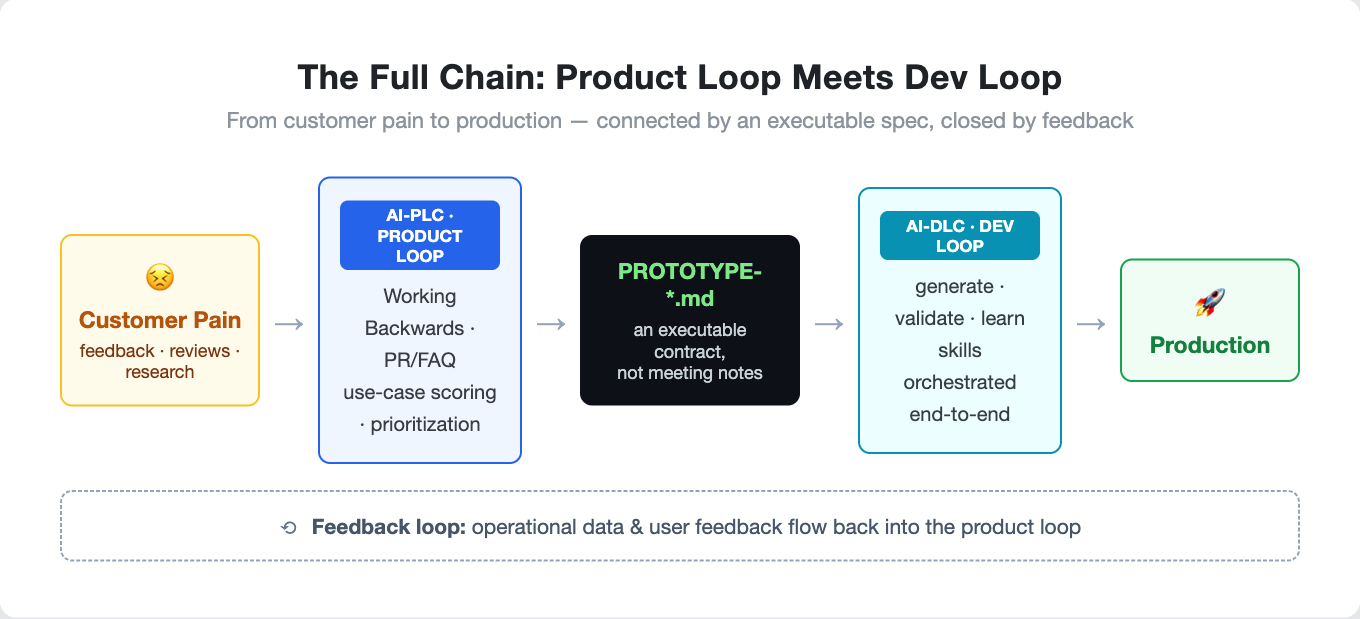
Second, every decision leaves an audit trail. Every input, choice, and rejection is recorded in audit files. Three months later, when someone asks “why did we kill that option,” nobody has to archaeologize chat logs.
See the structure? AI-PLC is a loop strapped onto product work: input (pain points / use cases), iteration (AI probing, scoring, generating), definition of done (spec file + approval), escalation (key decisions require a human call). The three-compartment model, identical — only the subject changed from code to business judgment.
From “hearing a customer complaint” to “clickable prototype”: one PM, one AI workspace, inside a week. Three years ago that was a department’s quarter.
How the Org Chart Actually Changes (the Point of This Article)
Setup complete. Now the title question: what exactly must change in a company’s organization to deserve the words “AI Native”?
The core judgment of this article: AI-DLC 2.0 looks like a development process specification. It is actually a design blueprint for an AI-Native organization. Every technical concept in it maps to an organizational institution that must be rewritten.
This judgment does not stand alone. Since late 2025, the major research houses have converged on the same direction: McKinsey named the paradigm of humans working side by side with AI agents the Agentic Organization, calling it the largest shift in operating models since the industrial and digital revolutions; Microsoft’s Work Trend Index describes the Frontier Firm, with a three-phase route — AI as assistant → human-agent teams → agent-operated, human-led — and predicts every employee becomes an agent boss; BCG’s mid-2026 client data shows early agentic adopters achieving roughly 3x productivity and 80% cycle-time reduction.
Directionally, consensus has formed. But those reports mostly stop at vision and phase diagrams — AI-DLC 2.0’s unique value is that it writes down the “how,” as an executable spec. The mapping table, row by row:
| AI-DLC 2.0 concept | Organizational counterpart |
|---|---|
| Three-compartment model (generate–validate–learn) | Rewriting job descriptions |
| Post-conditions / definition of done | Rewriting KPIs and acceptance criteria |
| Two kinds of validation (computational / inferential) | Reclassifying company policy |
| The Orchestrator’s five duties | The new middle-manager job description |
| The Skills library | Turning tacit knowledge into assets |
| Stopping conditions + escalation | Rewriting the delegation-of-authority system |
| Progressive hydration | The transformation roadmap itself |
6.1 Job descriptions: from “responsibilities” to three-compartment definitions
Traditional job descriptions list duties: “owns backend development,” “owns campaign planning.” AI-Native job descriptions are rewritten in three compartments: what are your inputs and outputs (compartment one)? How is your output verified correct (compartment two)? What rules does your work leave behind for the organization (compartment three)?
The clearer a role’s compartment two, the more of it AI can take over — and the more its human should move toward designing the validation rules. The genuinely endangered roles are the ones whose compartment two nobody can state — not because AI will replace them, but because nobody can say what value they create.
6.2 KPIs: from “humans reporting progress” to machine-verifiable completion
“80% done this week” is classic old-world reporting — measured by whom? With what? In an AI-Native organization, completion criteria are written as machine-checkable conditions wherever possible: test pass rates, zero linter violations, performance targets met, doc-code consistency checks green.
Whatever can be verified automatically no longer needs a status meeting; only what cannot be verified automatically deserves one. The rate at which your meeting count drops is an honest indicator of transformation quality.
6.3 Policy reclassification: which clauses of your employee handbook can become code?
Take the company rulebook — policies, security red lines, approval workflows — and ask of each clause: can this be written as a machine-executed check?
- Yes — e.g. “production database changes must include a rollback plan” — then write it as computational validation, install it in the pipeline, and stop routing it through human approval. Violations simply cannot be submitted; the approval meeting evaporates on its own.
- No — e.g. “brand-tone judgment for major campaigns” — then keep human judgment, but require the judge to write down their reasoning continuously, feeding compartment three, so it can be progressively distilled toward rules.
Policy shifts from “written for humans, enforced by conscience, backstopped by spot checks” to “partly compiled into machine-enforced code, partly human-judged but continuously distilled.” This is the deepest governance divide between AI-Native and traditional organizations.
6.4 The rebirth of middle management: the manager is a human orchestrator
Reread the Orchestrator’s five duties from section 4 — goal ownership, process composition, routing and control, abstraction boundaries, cross-cutting invariants. Replace “unit” with “team” and you have the job description of an excellent middle manager: owns the goal without deflecting; assembles teams by task instead of forcing one process; feeds each team the right inputs, tracks progress, escalates when needed; does not micromanage (treats teams as black boxes, verifies outputs only); personally guards the cross-team rules nobody else claims.
The difference: these duties used to depend on individual managerial talent, so quality varied. Now most of them — state tracking, routing, audit, stopping — can be executed mechanically by an orchestration system, and the manager keeps only the two hardest-to-automate duties: goal ownership and cross-cutting invariants.
So middle management doesn’t disappear — it bifurcates. Managers who made themselves information relays get replaced by the orchestration system directly. Managers who can define goals, guard horizontal rules, and design processes become the scarcest people in the building.
The new role already has a name. In February 2026, at the Future of Software Development retreat convened by Martin Fowler and Thoughtworks, participants named the work that is “neither writing code nor release management” Supervisory Engineering: directing agents, evaluating output, calibrating trust, encoding standards into systems, and defining the constraints within which agents can safely operate. Point for point, it is the technical edition of the human orchestrator’s job description.
6.5 Knowledge as an asset: people may leave; Skills stay
A traditional organization’s worst fear is the senior person walking out the door — the judgment in their head (how to review code, how to debug an incident, how to talk to customers) walks out with them. An AI-Native organization casts that judgment into Skills: loadable, composable, continuously improvable capability units. The veteran DBA’s experience becomes a “database design Skill”; the risk expert’s intuition is progressively distilled into a “risk check Skill’s” validation rules.
For the first time, organizational capability can exist — and compound — independently of specific people. It also redefines seniority: a senior person’s value is no longer monopolizing judgment but the ability to write judgment down as Skills. The more they teach, the less replaceable they become — because the hardest compartment-two rules always need the person who understands the domain best to define and iterate them.
6.6 Team shapes: three new departments
Put together, the delivery side of an AI-Native organization probably looks like this:
- Business delivery teams: small and full-stack. 3–7 people per direction, each spanning product–development–operations (agents do the execution; humans steer). OpenAI’s experiment is the prototype: 7 people doing what took 50, not by overtime but by each person managing a fleet of loops.
- The Harness platform team: the new infrastructure department. Platform teams used to run CI/CD and middleware; the core asset now is the company-grade Harness — context infrastructure, the validation rule library, the Skill library, orchestration, audit. This is the real moat of an AI-Native organization: anyone can buy the model; the Harness can only be grown.
- The rules engineering team (or virtual function): the compiler for policy. Staffed by the most senior engineers plus risk, compliance, and security experts, with one job — translating the company’s red lines, standards, and taste into machine-executable validation rules. This is the execution arm of 6.3.
Upstream, PM teams run the product-discovery loop with AI-PLC and hand executable specs straight to delivery teams. The wall between product and engineering is punched through by a PROTOTYPE file.
The Roadmap: No Big Bang — Progressive Hydration
By now you may be asking: fine in principle, but we carry years of legacy — where do we start?
AI-DLC 2.0 takes a notably sober stance: no organization reaches autonomous delivery overnight, and big-bang reforms fail. The prescribed path is called progressive Hydration — like filling a reservoir, expand the water where AI can act autonomously a little at a time:
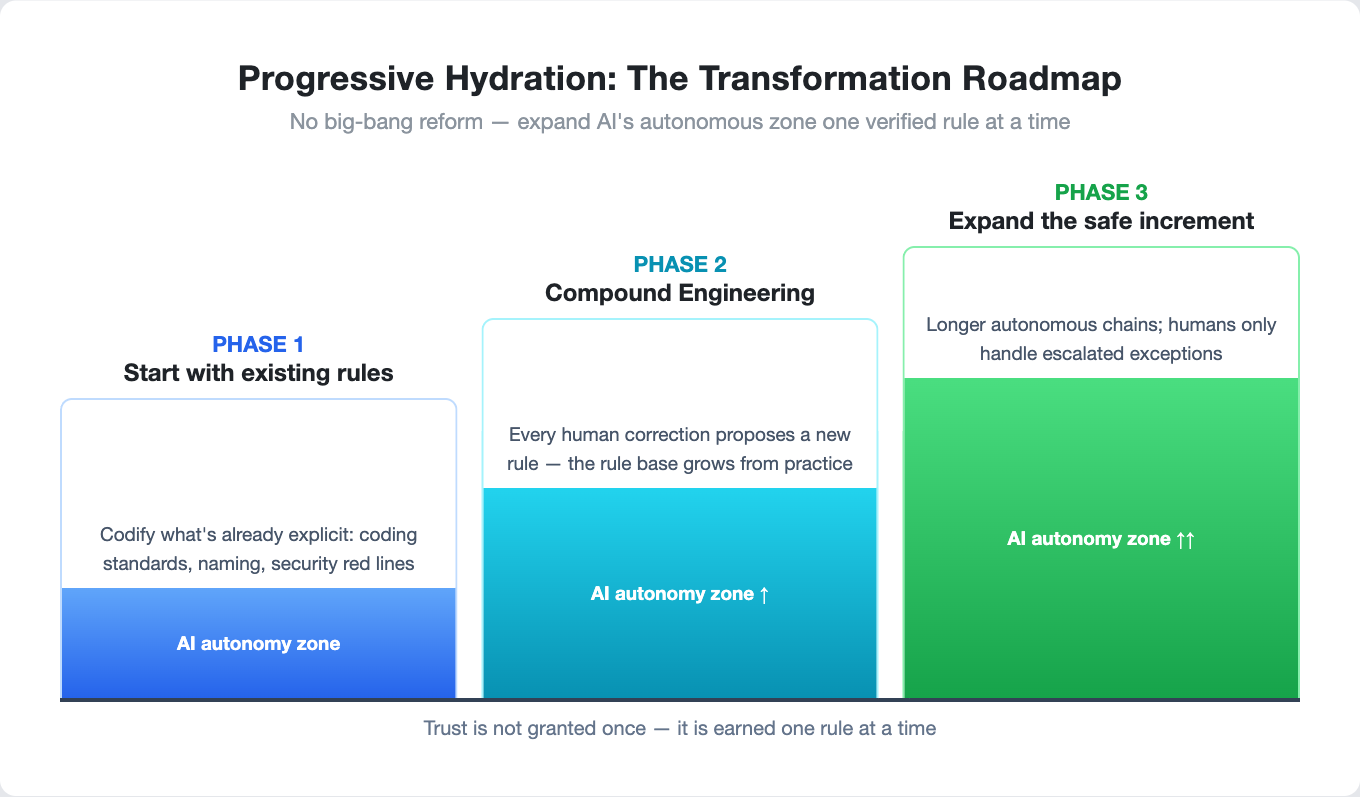
Step one: start from the rules you already have. Every company owns explicit rules today: coding standards, naming conventions, basic security red lines. Write those as machine-executable validations first, let AI work autonomously inside that small pool, and keep everything else on the human path. Don’t wait for a grand transformation program — you can start today.
Step two: continuous distillation — let practice generate rules. This is the spec’s finest design, called Compound Engineering: no human correction should be wasted. If reviewers keep rewriting the same class of AI output, the system should propose a new validation rule; if a design decision keeps getting overturned, a new guideline should be distilled. Rule proposals enter the rulebook after human approval — the organization’s verification capability grows out of practice instead of being hand-written behind closed doors by experts.
A traditional organization’s lessons live in retro documents nobody remembers three months later. An AI-Native organization’s lessons become pipeline checks — that class of mistake becomes physically impossible. That is the essential difference in how fast the two kinds of organizations learn: one relies on memory, the other on compounding.
Step three: widen the safe increment. The fuller the rulebook, the longer the chains AI can execute autonomously. First humans checked every step; then only key checkpoints; eventually humans handle only the exceptions the loops escalate. Trust is not granted once — it is earned one rule at a time.
The Legacy Health Check: A Brownfield Reality Test
Software engineering calls systems with historical baggage brownfield and clean new builds greenfield. Every shiny case study — OpenAI’s included — is greenfield. Your company is almost certainly brownfield.
The industry consensus is honest: pointing advanced automation at a brownfield system flips the car within weeks — AI generates chaos faster than humans can clean it up. Running agents on an architecturally murky legacy codebase is like running autopilot on a road with no lane markings. An early-2026 comparative case study (arXiv:2601.22667) contrasting a traditional enterprise’s brownfield environment with an AI-native startup’s greenfield reached the same conclusion: how much value an organization extracts from AI depends first on how digestible its existing engineering assets and structures are to AI — not on how expensive its tools are.
There is a “harness readiness” checklist on the technical side, and it maps straight onto the organization. Before high-intensity AI automation, answer three questions:
| Codebase check | Organization check |
|---|---|
| Can each module’s responsibility be stated in one sentence? | Can each department’s/role’s responsibility be stated in one sentence? |
| Are inter-module dependency boundaries enforced? | Are inter-team interfaces explicit — or is it group chats and shouting? |
| Is test coverage sufficient for AI to self-verify its output? | Do work products have objective acceptance criteria — or the boss’s gut? |
Fail the three questions and invest in readiness first — the good news being that AI itself dramatically accelerates the cleanup (docs, tests, interface clarification). “Sharpening the axe doesn’t delay the woodcutting” is literal here.
A counterintuitive warning: the transformation water level is set by your shortest plank, not your longest. One team built world-class context infrastructure (AI could read everything) while verification stayed fully manual — AI produced beautifully architected code, nobody ran integration tests, production burned daily. Only after automated verification arrived did all the context investment start paying out. When diagnosing where your transformation is stuck, find the weakest dimension; stop adding to the strongest.
Closing: The Organization Itself Is the Biggest Harness
Fold the four layers into one paragraph: individuals design loops instead of typing prompts; teams build environments instead of reviewing outputs; process is institutionalized through the three-compartment model, Skills, orchestration, and progressive hydration; the business puts product discovery into loops with specs as contracts; and the organization rewrites roles, KPIs, policy, middle management, and knowledge along all four layers.
Three closing judgments for decision-makers:
First, AI-Native is not “fewer people” — it is “different leverage.” OpenAI’s team went from 3 people to 7 — headcount grew, because each person’s output leverage was 10x. The goal of transformation was never layoffs; it is the same people doing ten times the work. An “AI transformation” whose goal is headcount reduction will lay off precisely the people who should have been designing the loops and the harness.
Second, the model is rented; the Harness is yours. Every competitor can use the same models, just as every company once bought the same servers. The gap grows elsewhere: how thick is your validation rulebook, how much judgment your Skill library has accumulated, what fraction of your policies has been compiled into machine-enforceable rules. None of it can be bought or copied — it only grows out of your own practice, day by day. That is the organizational moat of the AI era.
Third, management is becoming an engineering discipline. How goals are set, completion verified, exceptions escalated, lessons accumulated — things that once depended on individual managerial talent are being written down as specs, rules, and orchestration logic. The organization designers of the future need fluency in two things at once: human nature, and post-conditions.
A hundred-odd years ago, electric motors replaced steam engines — and for the first twenty years factory productivity barely moved. Owners had swapped the steam engine for a motor in place, leaving the entire plant layout, built around a central drive shaft, untouched. Only when someone realized motors could be distributed — every machine with its own power — and redesigned the whole factory floor did productivity finally explode.
Today’s AI is that electric motor. Any company can afford the engine. The resolve to redraw the factory floor plan is what’s scarce.
References
- Harness engineering: leveraging Codex in an agent-first world — OpenAI
- Loop Engineering — Addy Osmani
- AI-DLC Workflows 2.0 — AWS (awslabs)
- AI-PLC: AI-Driven Product Life Cycle — AWS (aws-samples)
- Humans and Agents in Software Engineering Loops — Kief Morris, martinfowler.com
- My AI Adoption Journey — Mitchell Hashimoto
- The Future of Software Development Retreat — Thoughtworks
- Measuring the Impact of Early-2025 AI on Experienced Open-Source Developer Productivity — METR