Anthropic Goes Big: Claude Fable 5 and Mythos 5 Are Here
On June 9, 2026, Anthropic shipped Claude Fable 5 and Mythos 5 simultaneously: the same underlying model, differing only in guardrails. Fable 5 is SOTA on nearly every benchmark, with the lead growing on longer tasks (Stripe migrated a 50-million-line codebase in one day). Priced at $10/$50 — less than half of Mythos Preview — and already live on Amazon Bedrock. Plus: why did the hidden Mythos suddenly come out of the vault?
中文版 / Chinese Version: Anthropic 放大招:Claude Fable 5 和 Mythos 5 来了
Mythos-class capability · Built-in safety guardrails · Available now on AWS
On June 9, 2026, Anthropic released two models at once: Claude Fable 5 and Claude Mythos 5. The same day, AWS announced Fable 5 was live on Amazon Bedrock. This article covers everything in one pass: where it’s strong, what’s new, what it costs, how to use it on AWS — and then a more interesting question: why did the Mythos model, hidden away for months, suddenly get released?
First, Sort Out: What Exactly Is Fable vs Mythos?
Above the Opus series, Anthropic carved out a higher capability tier: Mythos-class. In April, through “Project Glasswing,” they handed the first Mythos-class model (Mythos Preview) to a small group of cyber-defense organizations only. Ordinary users couldn’t touch it.
This time, Fable 5 and Mythos 5 are the same underlying model. The difference is one word: guardrails.
- Fable 5: guardrails on, available to everyone.
- Mythos 5: guardrails removed in certain domains, available only to a handful of vetted cybersecurity / life-science partners.
💡 Trivia: “Fable” comes from the Latin fabula — “a story that is told” — cognate with the Greek mythos. Different names, different guardrails, same soul.
Performance: The Longer the Task, the More Absurd the Lead
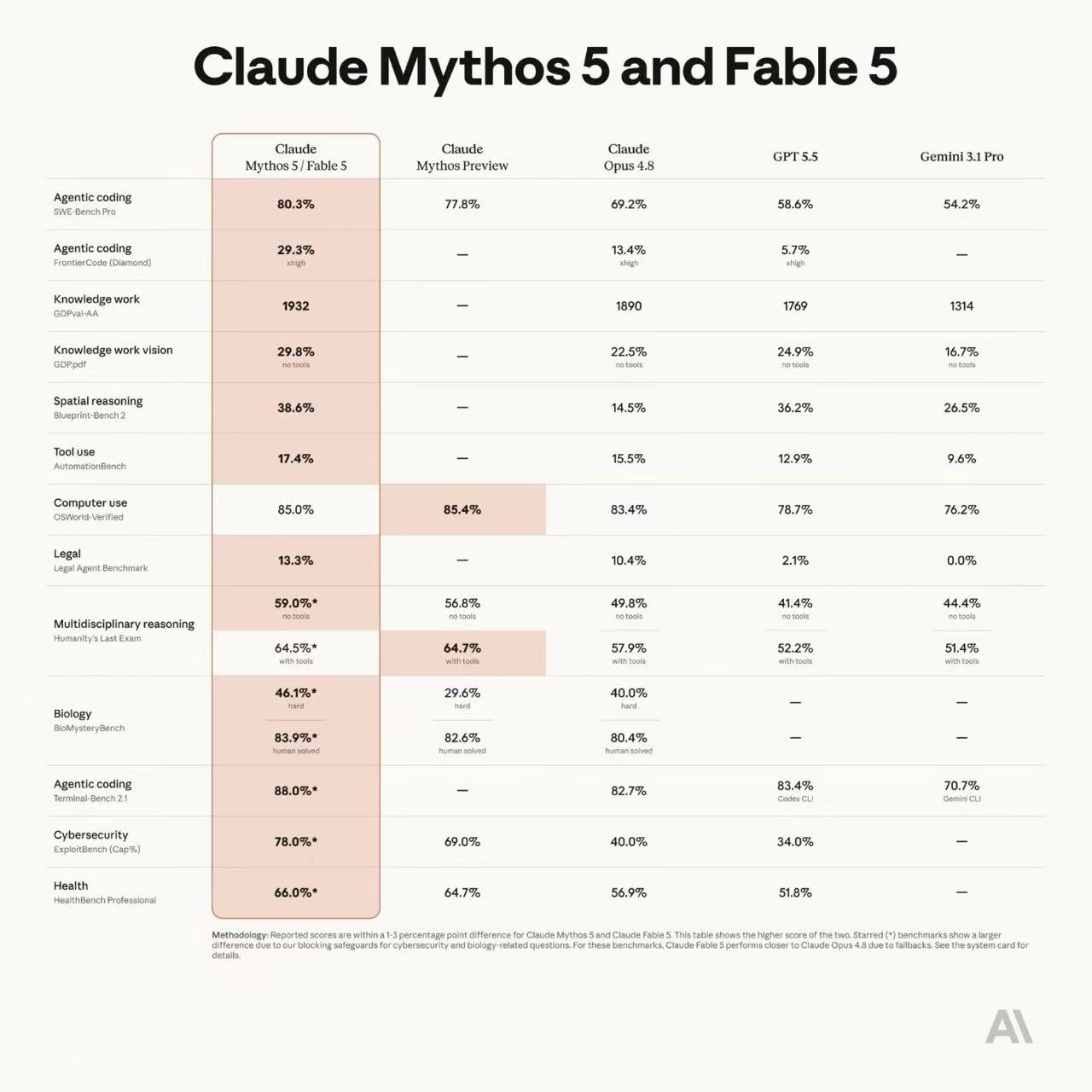 Mythos 5 / Fable 5 vs mainstream models (source: Anthropic)
Anthropic’s own words: Fable 5 is SOTA on nearly every benchmark tested. And there’s a crucial pattern — the longer and more complex the task, the wider the gap it opens over other models.
Early customer reports say more than benchmark tables:
- Stripe: compressed months of engineering into days. A full-repository migration in a 50-million-line Ruby codebase — over two months of manual work for an entire team — done by Fable 5 in one day.
- Coding: highest score on Cognition’s FrontierCode eval, while using fewer tokens — it takes first place even at medium effort.
- Financial analysis: top score among all models on Hebbia’s senior-level financial reasoning benchmark, with dramatically improved chart and table reading.
✦ One vivid example: previous Claudes needed a pile of auxiliary tools — maps, navigation aids — to barely play Pokémon FireRed. Fable 5 beat the entire game from raw screenshots alone. Pure vision.
The New Capabilities: It Can Do “Long Work” Now
Long-Horizon Autonomous Execution
The biggest change. Fable 5 executes complex coding and knowledge tasks for extended periods, asynchronously, without a human watching — the kind of work previous models couldn’t sustain.
Stronger Vision
It reads charts and tables nested inside PDFs and files, and can even reverse-engineer a webpage’s source code from a screenshot. While coding, it uses its “eyes” to check whether its output matches the goal — document-heavy fields like finance, law, analytics, and architecture benefit most.
Self-Verification and Self-Evolution
It updates its own skills based on what it learns, even building its own test harnesses and evaluation tools. Combined with file-based long-term memory, its memory-driven improvement in games like Slay the Spire is three times that of Opus 4.8.
Research Capability (Mostly Showcased on Mythos 5)
With Mythos 5, Anthropic’s in-house protein-design experts accelerated parts of drug-design workflows roughly 10x. In molecular biology, scientists preferred Mythos-generated hypotheses about 80% of the time in blind tests. It also ran over a week of independent genomics research, training a model that beat recent Science-published results at 1/100th the size.
Safety Guardrails: The Greater the Power, the Stronger the Backstop
A model this capable, running naked, could be weaponized in cybersecurity or biology. So Fable 5 ships with an independent classifier AI system dedicated to detecting abuse and jailbreak attempts.
The mechanism is elegant: when it detects sensitive requests involving cybersecurity, biochemistry, or model distillation, it doesn’t refuse — it automatically downgrades the request to Claude Opus 4.8, and tells you the switch happened.
Anthropic admits the guardrails are tuned conservative and occasionally hit legitimate requests. But the trigger rate averages below 5% — meaning over 95% of sessions are never downgraded, and in those sessions Fable 5 performs essentially identically to Mythos 5.
Mythos 5 is the version with those guardrails removed. It currently holds the strongest cybersecurity capability in the world, and is available only through Project Glasswing (in partnership with the US government) to a limited set of cyber defenders and infrastructure partners.
Pricing: Less Than Half of Mythos Preview
| Item | Price |
|---|---|
| Input (per million tokens) | $10 |
| Output (per million tokens) | $50 |
Fable 5 and Mythos 5 cost the same. To be clear, these are first-release models — there’s no “price-cut iteration” here. The “cheaper” comparison is against April’s first Mythos-class model, Claude Mythos Preview: less than half its price (per Anthropic). One detail: on AWS, if your request gets downgraded to Opus 4.8, that portion bills at Opus rates; if a conversation is intercepted mid-stream, earlier tokens bill at Fable rates and later ones at Opus rates.
How to Use It on AWS
Two paths: Amazon Bedrock, or Claude Platform on AWS (the native Anthropic platform experience). Bedrock example below.
Step 1: You Must Enable Data Sharing First
This is a hard gate. Before calling the model, enable provider_data_sharing via the Data Retention API. Anthropic requires 30-day data retention on all Mythos-class traffic, including human review — the goal is catching abuse patterns invisible within a single conversation. Note: once enabled, your data leaves AWS’s data and security boundary.
curl -X PUT \
  https://bedrock-mantle.us-east-1.api.aws/v1/data_retention \
  -H "x-api-key: <your-bedrock-api-key>" \
  -H "Content-Type: application/json" \
  -d '{ "mode": "provider_data_share" }'
Step 2: Call the Model
Option A: the Anthropic SDK over the Messages API (bedrock-mantle endpoint). First pip install anthropic:
import anthropic

client = anthropic.Anthropic(
    base_url="https://bedrock-mantle.us-east-1.api.aws/anthropic",
    api_key="<your-bedrock-api-key>",
)
message = client.messages.create(
    model="anthropic.claude-fable-5",
    max_tokens=4096,
    messages=[{"role": "user", "content": "..."}],
)
print(message.content[0].text)
Option B: stick with the familiar Invoke / Converse API (bedrock-runtime endpoint) via Boto3:
import boto3

rt = boto3.client("bedrock-runtime", region_name="us-east-1")
resp = rt.converse(
    modelId="global.anthropic.claude-fable-5",
    messages=[{"role": "user", "content": [{"text": "..."}]}],
    inferenceConfig={"maxTokens": 4096},
)
print(resp["output"]["message"]["content"][0]["text"])
Key points:
- Regions: currently live in US East (N. Virginia) and Europe (Stockholm).
- Access is rolling out to all AWS accounts; if you need it urgently, contact AWS Support.
- Mythos 5 on Bedrock is a Limited Preview, aimed at dual-use scenarios like cybersecurity and life sciences.
One More Thing: Why Did the Hidden Mythos Suddenly Come Out?
Put bluntly: in April, Mythos Preview was government-and-security-labs-only, wearing a “too dangerous for you” posture. Two months later, with a new name and a layer of guardrails, it’s open to everyone. That turn deserves scrutiny. A few observations — strictly my own reading:
- The official story is “the guardrails matured.” Anthropic’s narrative has always been: lock capability away first, release when safety measures are strong enough. This time they ran thousands of hours of external bug bounties and red-teaming, and claim no “universal jailbreak” was found. The story fits their persona, and it does have technical substance.
- But competitive pressure is the unavoidable reality. The frontier arms race never pauses. Keeping your strongest capability in a vault means ceding the market to rivals. Cutting the price by more than half and racing onto AWS / GCP / Azure simultaneously — that is an unambiguous land-grab move.
- Is it IPO staging, then? Can’t be concluded, but the timing is suggestive. Shipping the “world’s strongest” flagship while telling the “we’re the most responsible” safety story — for any company looking to raise its valuation and narrate a growth curve, that’s textbook material.
✦ My take: rather than “IPO staging,” call it a precise confluence of safety and commerce. Technically, the guardrails did improve — that’s the external confidence. Commercially, sitting on unmonetized frontier capability is an enormous opportunity cost. “Hide it first, then release it” is itself the best marketing script — it manufactures the scarcity of “too powerful to release,” then cashes in at the right window. Whether the timing tracks a capital-markets calendar, outsiders can only infer — but the commercial intent is written on its face.