I'm a Messi Fan, But I Asked the Strongest Model Ever — fable 5 — to Predict the World Cup. The Answer Hurt.
The 2026 World Cup semifinals are set, so I had Claude Fable 5 build a prediction model — Elo ratings, age-curve and tournament-experience adjustments, a dedicated penalty-shootout submodel — and run 1,000,000 Monte Carlo simulations. The result is the 'Argentina Paradox': Argentina has the highest probability of reaching the final (66.5%), yet Spain is the most likely champion (37.5%). A sensitivity analysis shows Messi's form is literally the dividing line.

中文版 / Chinese Version: 我是梅西球迷,但我让史上最强大模型 fable 5 预测世界杯冠军,答案扎心了
2026 World Cup · 1,000,000 Monte Carlo Simulations · Explained in 4 Charts
With Argentina’s 3–1 win over Switzerland, the semifinal bracket of this year’s World Cup in North America is complete: France vs Spain in the top half, Argentina vs England in the bottom. I didn’t sleep that night. As someone who has watched Messi for twenty years, I did something I might regret: I fed the bracket to fable 5 — the model billed as the strongest ever built — with one explicit instruction: don’t spare my feelings; let the data talk.
It did not spare them. At all.
It Doesn’t Guess Scores — It Builds a Model
I expected it to do what pundits do: talk about form, sprinkle in some mysticism. Instead, fable 5’s opening line was: “Predicting a single match is a false premise. I can only give you probability distributions.” Then it started building. I watched the whole thing. Four steps.
Step 1: Elo, Not FIFA Rankings
It rejected the FIFA rankings first — “a politically correct points table with distorted friendly-match weights” — and chose Elo ratings instead.
💡 What is Elo? A rating system invented by physicist Arpad Elo for chess in the 1960s, later ported to football (World Football Elo Ratings, covering every international match since 1872). The core idea in one sentence: your rating is a weighted memory of who you’ve beaten and who you’ve lost to.
- Beat a higher-rated team → big gain; beat a weak team → tiny gain
- Lose to a weak team → big loss; larger margins move ratings more
- World Cup matches carry 4x the weight of friendlies — you can’t farm points
Its most practical property: the rating gap converts directly into a single-match win probability — roughly 14 percentage points of win probability per 100 points of gap. That’s why the football-forecasting community treats it as far more reliable than FIFA rankings.
The conversion formula looks like this:
# Elo gap → single-match win probability
P(A beats B) = 1 / (1 + 10^(-(Elo_A - Elo_B) / 400))

# Example: Spain 2208 vs France 2085, gap = 123
# → Spain's open-play win probability ≈ 66.9%
Step 2: Two Adjustments — One of Them Stabbed Me
Raw Elo isn’t enough, so it layered on two corrections.
The age-curve adjustment: sports science puts a player’s peak at 25–28, and a squad whose average age drifts from that window loses points. Then it deadpanned a list of numbers at me: Messi is 39, Di María has retired from international football, Otamendi is 38 — Argentina docked 22 points, the only negative adjustment among the four. And Spain? Yamal, Pedri, Cubarsí — average age just over 25, dead center of the golden window: +18.
The tournament-experience adjustment salvaged some of my pride: 2021 Copa América, 2022 World Cup, 2024 Copa América — three straight titles, nearly unbeaten in knockout matches across three major tournaments — Argentina +25, highest of the four. England, with back-to-back final defeats and a well-documented big-match mental burden, got −10.
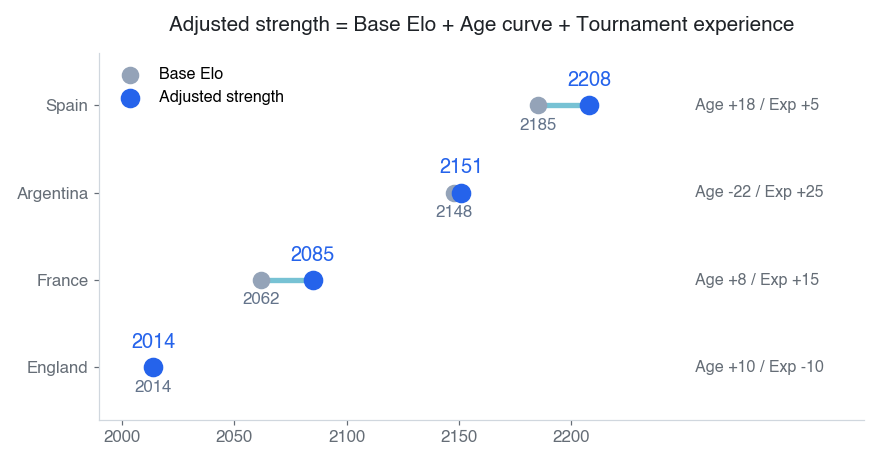
After adjustments: Spain at 2208, clear of the field; Argentina hanging on to second at 2151 thanks to the experience bonus; France 2085; England 2014. Look at Argentina’s line — the age penalty is almost exactly paid back by the three-peat experience bonus, netting out at +3. This team is fighting time with championship pedigree.
Step 3: A Dedicated Model for Penalty Shootouts
This is the part I found most rigorous. Roughly a quarter of World Cup knockout matches historically go to extra time or penalties, and a shootout is a fundamentally different game from open play. fable 5 computed a separate shootout coefficient for each team — goalkeeper save data plus takers’ historical conversion:
- Argentina 0.62 (highest of the four): Emiliano Martínez’s name alone is the argument — won both shootouts at the 2022 World Cup, unbeaten on penalties across his last three major tournaments. The king of knockouts.
- Spain 0.50, France 0.48: unremarkable
- England 0.42 (lowest of the four): among the worst historical shootout records in Europe. That’s data, not slander.
Step 4: Run a Million Parallel Universes
Finally, the Monte Carlo simulation: one full pass through both semifinals plus the final counts as one universe. Run a million universes, count how many times each team lifts the trophy. Each match first decides — based on the strength gap — whether it ends level and goes to penalties (the closer the teams, the likelier extra time), and if it does, the shootout submodel takes over. The core logic is under 30 lines:
for i in range(1_000_000):
    f1 = knockout("France", "Spain")       # Semifinal 1
    f2 = knockout("Argentina", "England")  # Semifinal 2
    champion = knockout(f1, f2)            # Final
    count[champion] += 1

# Inside knockout(): evenly matched → higher chance of penalties
# Shootout → switch to each team's shootout coefficient
To be clear, one million is not a figure of speech — it’s the actual iteration count, and it took a few seconds on my Mac. Why so many? Monte Carlo precision converges with sample size: at a million runs, the error on the probability estimates is under ±0.1 percentage points — enough to support the decimal-level conclusions below. (The sensitivity analysis later uses 200,000 runs per configuration, ±0.2 points of error — also sufficient.)
The Semifinals: One Reincarnation, One Conversation for the Ages
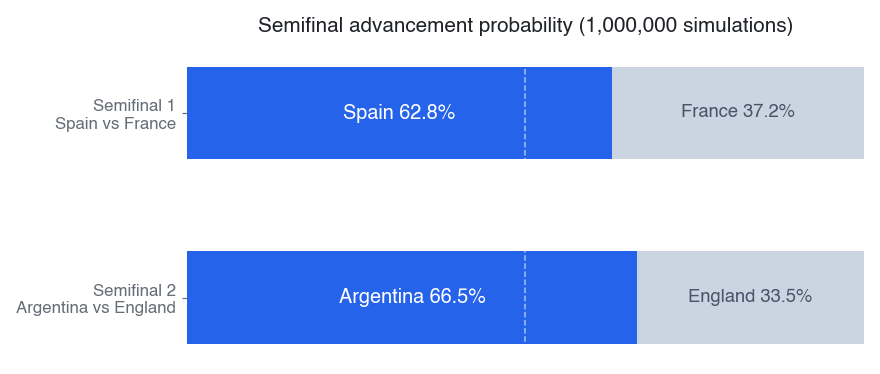
🇫🇷 France vs 🇪🇸 Spain: Spain 62.8%
The highest-quality matchup of the tournament. Spain carries the core of its Euro 2024 championship squad, an entire team on the rise; France’s trump cards are a 27-year-old peak Mbappé and the tournament DNA of back-to-back World Cup finals. But fable 5 flagged a detail: at Euro 2024, Spain already beat France in open play in the semifinal. In the simulations, most of France’s comeback scripts depend on an individual Mbappé explosion — and betting on a single point of brilliance is exactly the kind of win probability models trust least.
🇦🇷 Argentina vs 🏴 England: Argentina 66.5%
Maradona’s “Hand of God” in 1986; forty years later, Messi’s last dance against the Three Lions — the script alone is worth the ticket. On paper England is younger: Bellingham, Saka, Foden all entering their primes. But the simulation produced two details that favor us enormously:
📊 Detail 1: This match has a 25.0% probability of going to a shootout — and once it does, Martínez’s coefficient edge over England’s goalkeeper pushes Argentina’s win probability to 59.6%.
📊 Detail 2: Of England’s 33.5% advancement probability, only 10.1 percentage points come via penalties — meaning seven times out of ten, England must finish the job before a shootout to go through. The longer the match runs, the more it belongs to Argentina.
The Answer from a Million Universes: The Argentina Paradox
When fable 5 threw the results of a million runs at me, I stared at the screen for a long time:
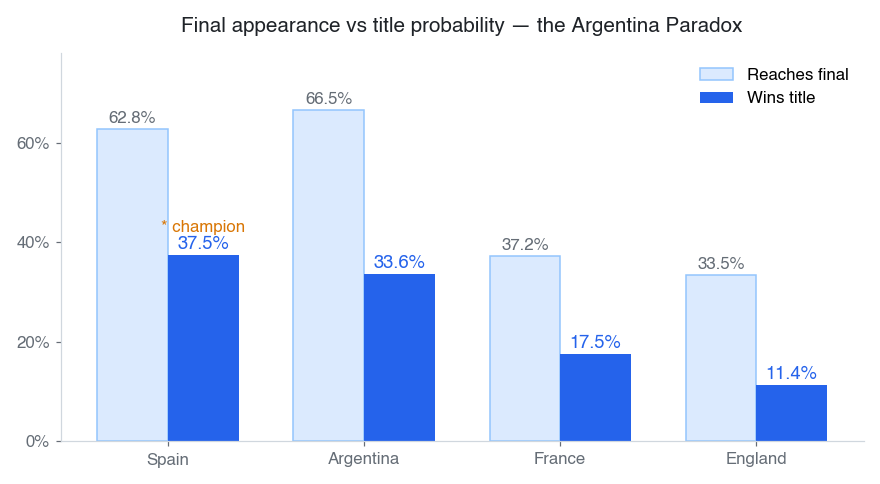
See the twisted part? Argentina has the highest probability of reaching the final (66.5%), yet the most likely champion is Spain (37.5% vs 33.6%). I call this the “Argentina Paradox.”
The answer hides in final conversion rates. fable 5 computed each team’s conditional probability of winning the trophy given they reach the final: Spain 59.7%, Argentina just 50.6%. Why? Because when Argentina reaches the final, Spain is waiting in 41.8% of those universes — and in that single match, Spain wins 54.1% of the time. A golden generation of 25-year-olds against a 39-year-old king: over 90 minutes of open play, the age curve is merciless.
⚠️ But the model also computed Argentina’s path to victory: in the Spain–Argentina finals that Argentina wins, 36.3% are won in a penalty shootout; across all of Argentina’s championship scripts, about a third run through final-match penalties. Translation: drag the match into extra time and place your fate in Emiliano Martínez’s hands — that is, by the data, our most realistic route to the title. It’s exactly what we did to France in 2022.
I Wasn’t Ready to Give Up: One More Sensitivity Analysis
Staring at 37.5% vs 33.6%, I asked fable 5 one last question: “What actually decides this 3.9-point gap?” It didn’t answer directly. Instead it re-ran six batches of simulations — every other parameter frozen, adjusting only Argentina’s age modifier, from −40 (Messi completely done) to +10 (Messi back at his 2022 level):

The two lines cross at age adjustment ≈ 0. In plain language: if 39-year-old Messi can perform without decline, Argentina’s championship probability overtakes Spain’s and they become the favorite. A million simulations, four teams, three matches — and the final dividing line lands on one man’s form. fable 5 titled this chart itself, and I didn’t change a word: “Messi’s form is the dividing line for where the trophy goes.”
✦ fable 5’s Final Prediction
🏆 2026 World Cup champion: Spain (37.5% probability)
🥈 Final opponent: Argentina (33.6%; 66.5% probability of reaching the final — highest of the four)
⚽ Most likely final: Spain vs Argentina (plays out in 41.8% of universes)
🎯 Argentina’s championship path: extra time → penalty shootout → the Martínez moment
🔮 Suspense index: extreme — a 3.9-point gap that one man’s form can erase
Closing Thoughts: Probability Handles Reason; Football Handles Miracles
Honestly, seeing “Spain wins” on that line choked me a little. But then: what does 33.6% actually mean? In a million parallel universes, there are 336,000 in which a 39-year-old Messi lifts the World Cup for the second time on a summer night in America.
And don’t forget — before the 2022 tournament, not a single mainstream model had Argentina as the favorite, and we lost the opener to Saudi Arabia. Then what happened? Messi lifted the trophy at Lusail. Models have a prior record of underestimating Argentina.
✦ A model can compute probability. It cannot compute faith. Spain wins on expected value; Argentina wins on variance — and a World Cup final is precisely the highest-variance 90 minutes on Earth. The data says Spain 37.5%. My heart says Argentina 100%. Vamos Argentina — go turn that 33.6% into reality.
Disclaimer: This article is a probabilistic exercise by an AI model based on historical data. Parameter choices involve subjective assumptions. For fan entertainment and discussion only — not betting advice. Football is round, and that is exactly why we love it.