Kimi K3 Is Here: 2.8 Trillion Parameters, Fully Open Source — This Time It's Different
Moonshot AI releases Kimi K3: 2.8 trillion parameters, the world's first open-source 3T-class model, 1M-token context, and native multimodality. A deep dive into the KDA and AttnRes architecture innovations, its #4 global ranking on Artificial Analysis, pricing that matches Claude Sonnet 5, and the four long-term ways an open frontier model reshapes the industry.
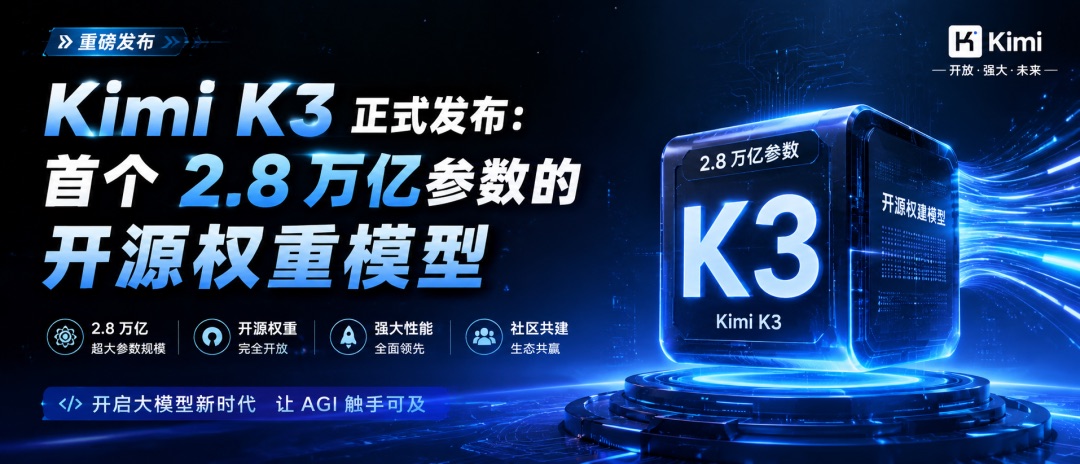
中文版 / Chinese Version: Kimi K3 正式发布:2.8 万亿参数全开源,这次真的不一样
The largest open-source model in history · Frontier intelligence · A watershed moment for the open-source ecosystem
On July 16, Moonshot AI officially released Kimi K3 — 2.8 trillion parameters, the world’s first open-source 3T-class model, with all weights to be released by July 27. This article isn’t just about parameters and benchmark scores. It’s about a bigger question: what does it mean for the entire industry when the weights of a frontier-class model are simply handed to everyone?
What Actually Happened
On Thursday, July 16, Moonshot AI launched Kimi K3, opening the API and developer documentation at the same time. The official blog post is restrained in tone, but put the numbers side by side and the weight is obvious:
- 2.8 trillion total parameters: the world’s first open-source 3T-class model, 75% larger than DeepSeek V4 Pro (~1.6T)
- 1M-token context window: enough to swallow an entire large codebase
- Native multimodality: text, images, and video processed in one model — not a bolted-on vision encoder
- All weights open-sourced by July 27: not a crippled variant — the full model
The timing is delicate too — right before the 2026 World AI Conference (WAIC) in Shanghai. DeepSeek V4 had dominated headlines the day before; K3 followed immediately. China’s open-source model arms race is now measured in weeks.
💡 There’s a telling line in the official blog: over the past 12 months, the “size ceiling” for open-source models was held by the Kimi series for 9 of those months. K3 is the continuation of that trajectory — and its current peak.
What’s Actually New Technically
2.8T parameters sounds intimidating, but what makes K3 worth discussing isn’t “big” — it’s how it makes “big” trainable, deployable, and affordable.
Extreme-Sparsity MoE: 16 Out of 896
K3 uses a Mixture-of-Experts architecture with 896 experts, activating only 16 per token. In plain terms: the total parameter count is 2.8T, but only a small fraction actually “works” on each inference step. This sparsity level is aggressive by industry standards. To make it work, Moonshot built the Stable LatentMoE framework plus a routing-balance method called Quantile Balancing, which derives expert assignment directly from the quantiles of routing scores — eliminating one of the most notoriously hard-to-tune hyperparameters.
Two Architectural Weapons: KDA and AttnRes
Kimi Delta Attention (KDA) keeps attention viable over ultra-long sequences — according to The Decoder, KDA speeds up decoding at 1M-token context by up to 6.3x. Attention Residuals (AttnRes) changes how information flows through the model’s depth: instead of accumulating uniformly layer by layer, representations are selectively retrieved across layers. Official numbers: ~25% training efficiency gain at under 2% extra compute.
Add it all up and K3 achieves roughly a 2.5x improvement in overall scaling efficiency over K2. Same compute, more intelligence. Keep that number in mind — it comes back when we talk about industry impact.
Paving the Road for Open-Source Deployment
One easily overlooked detail: K3 has been trained with quantization-aware training (QAT) since the SFT stage, using MXFP4 weights and MXFP8 activations. Translation: the model ships factory-designed for low-precision inference, with hardware compatibility maxed out. Moonshot also pre-contributed its KDA prefix-cache implementation to the vLLM community, to be released alongside the model.
🔍 This move deserves a close look. The usual pattern is “release the model, let the community figure out how to run it.” Moonshot’s pattern is “write the inference-framework adaptation code before releasing the model.” Open-sourcing isn’t just dumping weights — it’s preparing the entire usability chain. That said, the official recommendation is deployment on super-nodes with 64+ GPUs — far too high a bar for individual developers. K3’s open-source dividend belongs, for now, to enterprises and cloud providers.
Performance: Not Quite the Strongest, But Frightening Enough
Start with Moonshot’s own framing, which I find refreshingly honest: K3 still trails Claude Fable 5 and GPT-5.6 Sol overall, but consistently leads every other model tested.
Independent evaluator Artificial Analysis confirms that assessment. On its Intelligence Index, K3 scores 57 — fourth in the world:
| Model | Intelligence Index | Open Source |
|---|---|---|
| Claude Fable 5 | 60 | No |
| GPT-5.6 Sol | 59 | No |
| Kimi K3 | 57 | Yes |
| Claude Opus 4.8 | 56 | No |
Note what this ranking means: a model about to be fully open-sourced has overtaken Anthropic’s Opus 4.8. The gap between open source and the closed-source frontier has shrunk from “a generation” to “half a step.”
The individual benchmarks are even more interesting. K3 reaches the top tier — or the top spot — on Terminal Bench 2.1 (88.3), BrowseComp (91.2), SWE Marathon (42.0), and OmniDocBench (91.1). The result that went viral: on Arena.ai’s frontend code arena, K3 ranked #1, unseating Claude Fable 5 just six weeks after Fable’s release.
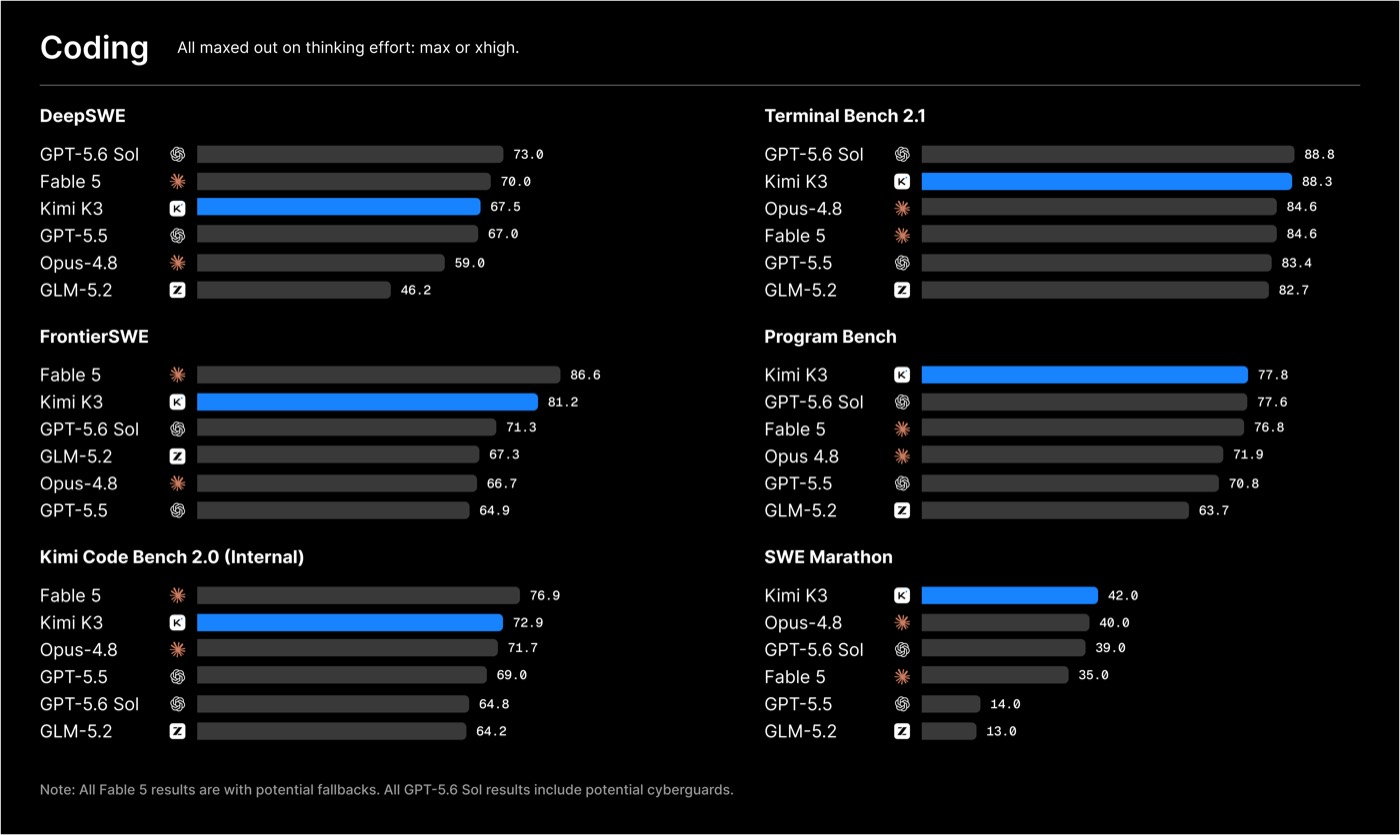 Official coding benchmarks: K3 leads on Terminal Bench, Program Bench, and SWE Marathon | Source: Moonshot AI official blog
✦ Arena’s CEO, verbatim: Arena CEO Anastasios Angelopoulos wrote on X: “This might be the biggest release of the year, marking the moment Chinese open-source models overtook American ones. On Code Arena, Kimi K3 beat Fable — just six weeks after Fable’s release.” Former White House AI policy advisor Sriram Krishnan called it “a big moment with multiple implications for the industry.”
On agentic tasks, the leap is even more dramatic. K3’s GDPval v2 Elo jumps from the previous generation K2.6’s 1190 straight to 1668; on the long-horizon knowledge-work benchmark AA-Briefcase, it gained 732 Elo points. That’s not an iteration — that’s a generational change.
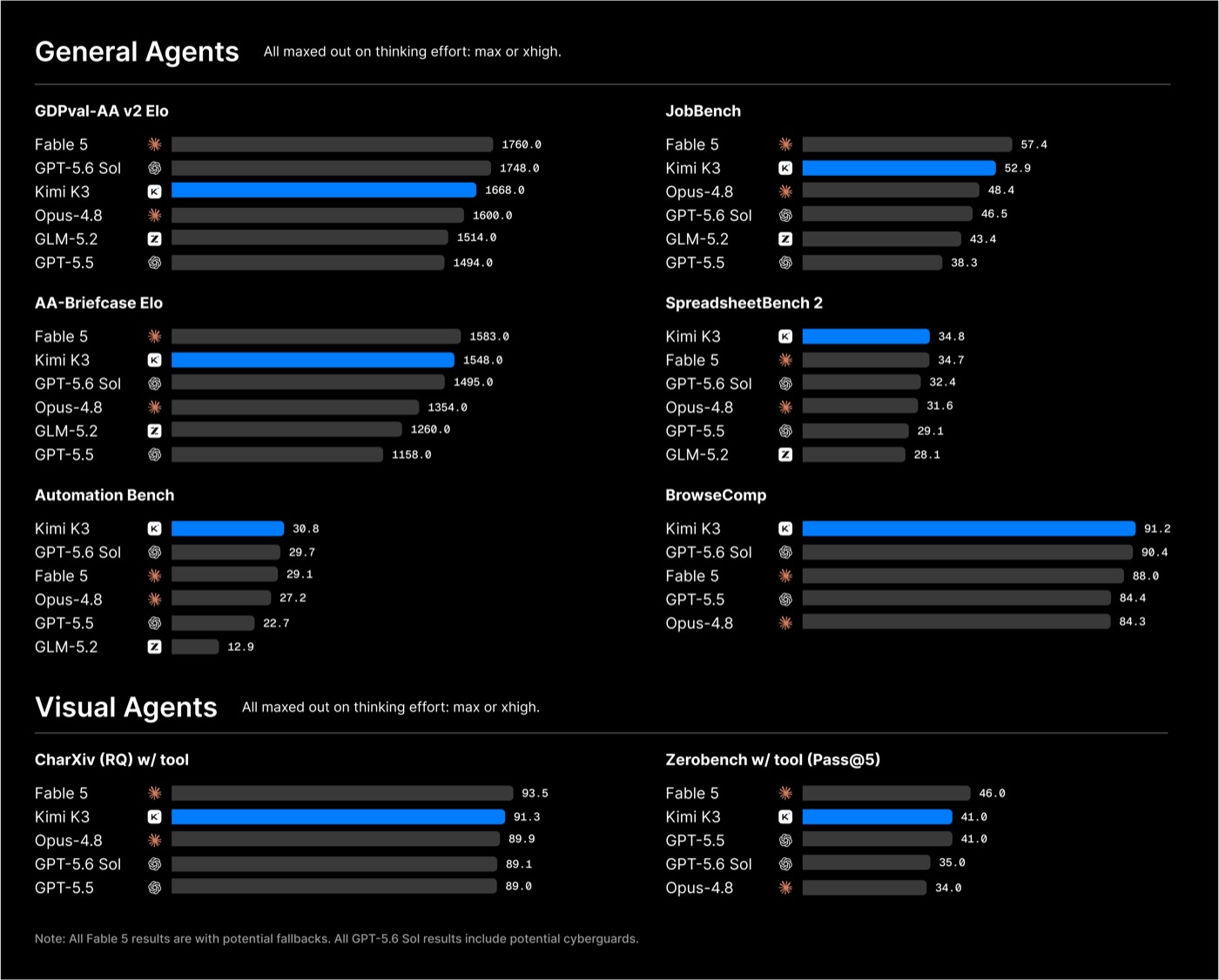 General/visual agentic benchmarks: K3 ranks first on Automation Bench, BrowseComp, and SpreadsheetBench 2 | Source: Moonshot AI official blog
What It’s Built For: Not Chat — Long-Horizon Work
Product-wise, K3 isn’t aimed at chatbots at all. It targets agents that work autonomously for extended periods: reading large codebases, orchestrating terminal tools, and pushing tasks forward with minimal human intervention. The official demos make the point:
- Designed a chip autonomously in 48 hours: using open-source EDA tools on the Nangate 45nm process library, K3 independently built, optimized, and verified an AI inference chip — 4 mm², 1.46 million standard cells, simulated decoding throughput above 8,700 tokens/s. The official tagline is delicious: “a chip designed by a model, for models.”
- Wrote a GPU compiler from scratch: K3’s MiniTriton comes with its own IR layer, optimization passes, and PTX code generation. It matches or beats Triton and torch.compile on several benchmarks, and holds up under end-to-end nanoGPT training.
- Reproduced astrophysics research in 2 hours: cross-validating 20+ papers, evaluating 300+ equations of state, and writing 3,000+ lines of Python to reproduce the I-Love-Q universal relations — work that typically takes an experienced researcher one to two weeks.
The other keyword is “vision in the loop”: K3 can look at a screenshot, change the code, then look at the result — a closed loop. That makes it formidable in domains where seeing is believing: game development, frontend, CAD. The Code Arena win over Fable? That’s exactly how.
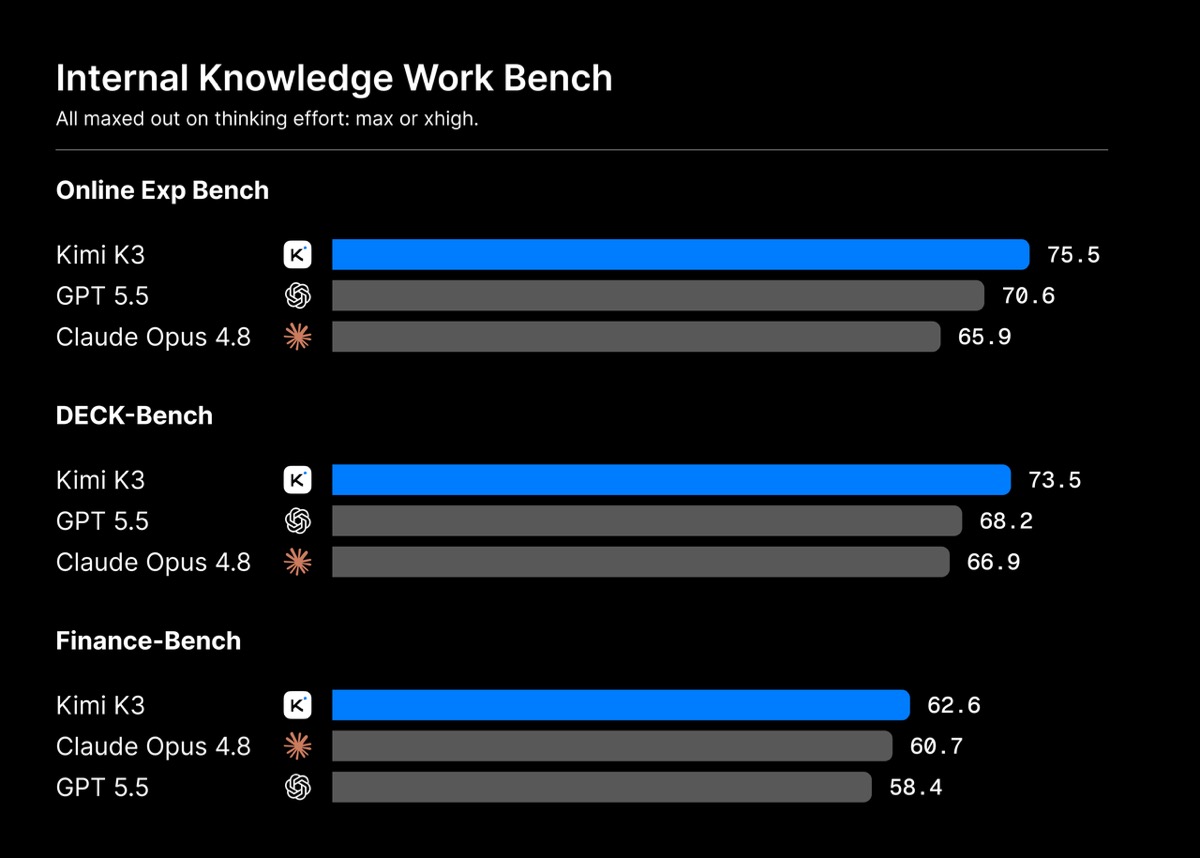 Official internal knowledge-work evaluation: K3 leads in online experience, slide creation, and financial analysis | Source: Moonshot AI official blog
Pricing: The Era of Ultra-Cheap Chinese AI Is Over
This may be the most telling signal of the whole release. K3’s API pricing: $3 per million input tokens ($0.30 on cache hits), $15 per million output tokens. Compare:
| Model | Input $/M | Output $/M |
|---|---|---|
| Kimi K3 | 3.00 | 15.00 |
| Kimi K2.6 (previous gen) | 0.95 | 4.00 |
| Claude Sonnet 5 | 3.00 | 15.00 |
| GPT-5.6 Sol | 5.00 | 30.00 |
| Claude Fable 5 | 10.00 | 50.00 |
See it? K3’s pricing matches Claude Sonnet 5 to the cent — and is more than triple its own previous generation. The Decoder’s verdict on this phenomenon: Chinese vendors are no longer selling frontier models at floor prices. “The era of ultra-cheap Chinese AI” is ending.
But look at it from another angle and the pricing is actually clever. By Artificial Analysis’s measurement, K3 costs about $0.94 per task — roughly even with GPT-5.6 Sol ($1.04) and half of Opus 4.8 ($1.80). Mid-tier price, near-frontier capability. Token efficiency improved too: completing the same evaluation suite, K3 emits 21% fewer output tokens than K2.6 while scoring 13 points higher.
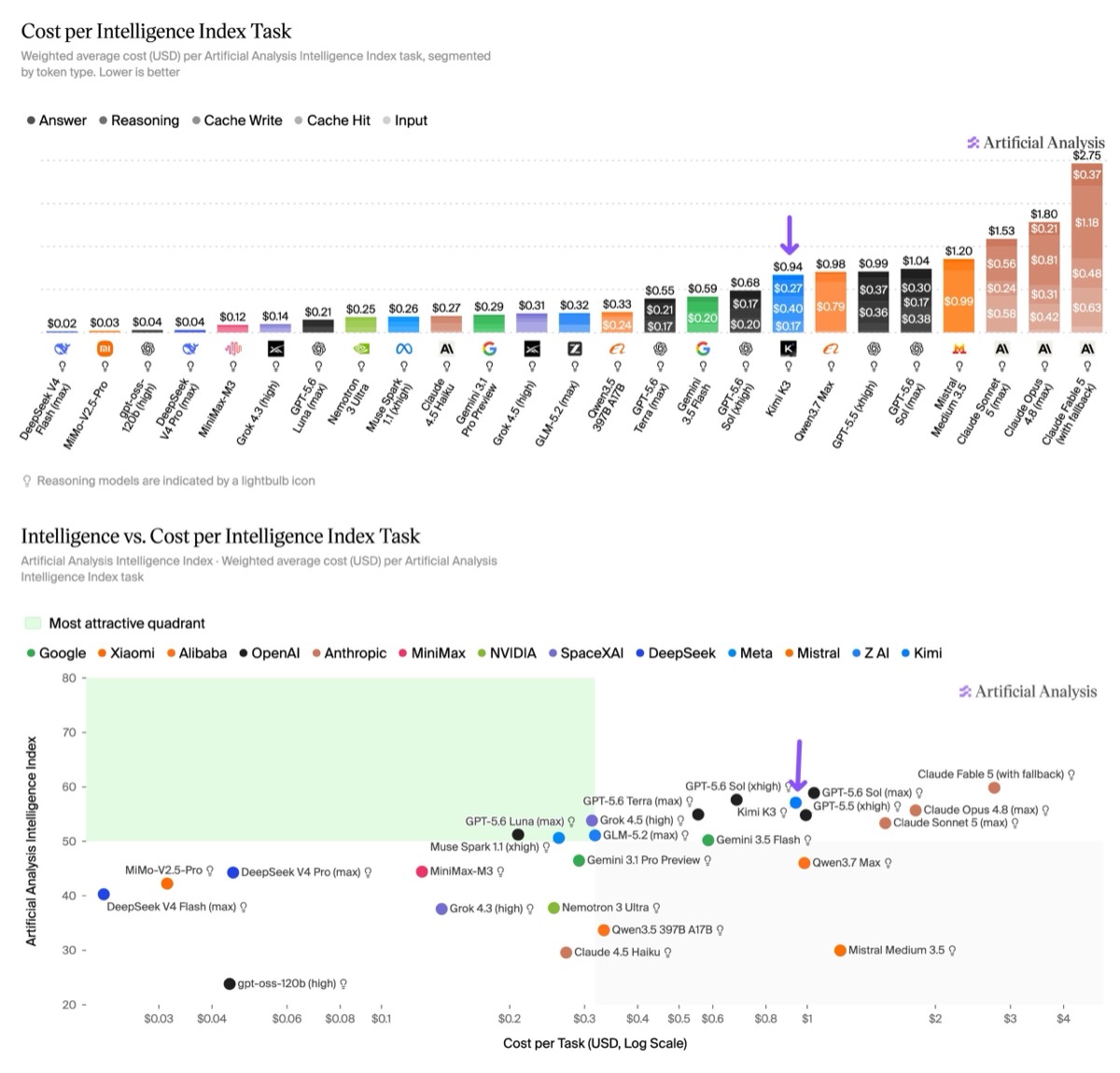 Cost-per-task comparison and the intelligence-vs-cost scatter: K3 lands at near-frontier intelligence, mid-tier price | Source: Artificial Analysis
⚠️ One practical note: K3’s pricing is flat regardless of context length — a full 1M-token context costs the same rate. Combine that with the official API’s 90%+ cache hit rate in coding scenarios (powered by the Mooncake disaggregated inference architecture), and real-world costs can land well below list price. If you’re building agent applications, run these numbers carefully.
What an Open-Source 3T Model Means Long Term
Now the main event. Parameters, benchmarks, and prices are all “now.” Releasing 2.8T weights into the world is “long term.” I see four layers.
Layer 1: Frontier Capability Is No Longer a Members-Only Club
For the past two years, the industry ran on an unspoken hierarchy: the strongest models are always closed-source, and open source declaring victory meant catching up to “last generation’s closed-source level.” K3 breaks that line — it beats Opus 4.8 on the intelligence index, defeats a prime-of-life Fable 5 on frontend code, and then says: in ten days, the weights belong to everyone.
That means any institution with compute — university labs, sovereign AI programs, banks and hospitals with hard data-compliance requirements — can run a near-frontier model in their own data center without handing data to any API vendor. For closed-source vendors, the depreciation clock on the “capability lead” moat just switched from years to months. Fable 5 held its lead for six weeks before being caught on one benchmark.
Layer 2: The Research Ecosystem Gets an Anatomy Textbook of a Frontier Model
KDA, AttnRes, Stable LatentMoE, Quantile Balancing, Per-Head Muon… these aren’t just marketing names. Once released with the weights and technical report, they become objects the world’s researchers can reproduce, remix, and falsify. Recall what happened after DeepSeek open-sourced MLA and GRPO — how many papers and follow-up models stood directly on those shoulders? K3’s complete engineering answer to “how do you push MoE to 3T without training collapse” may be worth more than the model itself.
And don’t forget that detail: Moonshot pre-contributed the KDA prefix-cache implementation to vLLM. Every time open-source infrastructure (vLLM, SGLang) absorbs a new architecture, the whole community digests the next new architecture faster. That’s compounding.
Layer 3: Another “DeepSeek Moment”? The Geopolitical Table Reshuffles
Many Western outlets compare K3 to DeepSeek R1 in early 2025. Back then, R1’s release briefly erased about a trillion dollars of US tech market cap, and the White House tightened technology export controls in response. This time, SiliconANGLE’s judgment: the consensus that “American AI companies lead their Chinese counterparts by months” no longer holds.
The backdrop makes it spicier: just months ago, Anthropic accused Moonshot, DeepSeek, and MiniMax of improperly “distilling” Claude’s capabilities. Post-K3, expect another round of debate around distillation, export controls, and security review of open-source models. But one fact is hard to argue with — under compute constraints, Chinese teams are closing the gap through architectural innovation and engineering efficiency. K3’s 2.5x scaling-efficiency gain over K2 is the most direct evidence.
Layer 4: The Open-Source Business Model Is Proving Itself
“If it’s all open-source, how do you make money?” K3 offers an increasingly clear answer: the weights are open, but the official API achieves 90%+ cache hit rates through the Mooncake inference architecture — cost and experience that others can’t copy overnight. Above that sit Kimi Work, Kimi Code, Kimi Enterprise, and a managed agent platform. Open-source the model to drive adoption and build the ecosystem; charge for infrastructure and products — a playbook that looks more like Linux/Red Hat every day.
Four Takeaways for Practitioners
Whether you build models, build applications, or set AI strategy inside a large company, this release carries signals worth genuine thought.
✦ Takeaway 1: Scaling parameters requires scaling architecture first. K3 dares to go to 2.8T not because Moonshot has the most compute, but because KDA + AttnRes + extreme-sparsity MoE raised output per unit of compute by 2.5x. The inverse also holds: without breakthroughs in architecture and training methods, stacking parameters is just burning money. “Scaling isn’t dead — naked scaling is.”
✦ Takeaway 2: The main battlefield has moved to long-horizon agents. Every muscle K3 flexes — 48-hour chip design, a compiler from scratch, research reproduction in 2 hours — is “working autonomously for a long time.” The differentiation space in chat experience keeps shrinking. Whoever can make a model run a multi-day engineering task independently and reliably holds the pricing power of the next round. If you build applications, rethink your moat in this direction.
✦ Takeaway 3: Open source isn’t charity — it’s a strategic weapon. For a challenger, open-sourcing is the sharpest offensive move: free weights dissolve the leader’s API premium, and ecosystem capture buys standard-setting power. Meta played this card with Llama; now Chinese companies are playing it at the frontier level. If you’re in the closed-source camp, you must answer a hard question: when “good-enough open source” trails you by half a step at a 70% discount, why do customers stay? The answer can only live outside the model — toolchain, reliability, compliance, service.
✦ Takeaway 4: The race to the bottom is receding; value pricing is back. K3 pricing itself against Claude Sonnet 5 — triple its previous generation — says top Chinese vendors are done with price wars: when the capability arrives, they charge for it. For downstream application companies, this is a warning: the window for “cheap models” as a business model is closing. Real cost optimization comes from engineering — caching, token efficiency, task orchestration.
A Cold Shower: It Has Real Weaknesses
After all the praise, some cold water. Several problems are on the table, acknowledged by both Moonshot and third parties:
- Hallucination rate went up, not down: Artificial Analysis measured K3’s hallucination rate at 51%, up from the previous generation’s 39% — more correct answers, but also more confident fabrication. For serious applications this is a hard flaw that engineering guardrails must absorb.
- “Over-proactive”: Moonshot itself admits K3 likes to make decisions for the user when instructions are ambiguous. Agents in serious business settings need tight constraints in the system prompt.
- Sensitive to reasoning history: K3 requires the harness to pass back complete prior thinking content; switching mid-task from another model can be unstable. Ecosystem adaptation will take time.
- Overall experience still trails: in Moonshot’s own words — compared with Claude Fable 5 and GPT-5.6 Sol, there remains a “perceptible gap” in user experience.
- Extremely high deployment bar: 64+ GPU super-nodes recommended. “Open source” does not mean “usable by everyone.” Individual developers will be on APIs or cloud providers for a while.
Closing Thoughts
K3 is not “the strongest model” — even Moonshot doesn’t claim that. But it may be the most important open-source release yet: it proves an open model can stand at the door of the frontier club, proves architectural efficiency can offset compute disadvantage, and declares that open-source AI has moved from “the budget substitute” to “head-on competition.”
After the weights drop on July 27, the real story begins: who catches these 2.8T parameters? What fine-tunes, distillations, and industry-specific models grow from them? Do the closed-source giants respond with price cuts or faster iteration? The answers to those questions will define the second half of 2026 in AI far more than any benchmark table.
Once the technical report is out, I’ll follow up with a deep dive into the KDA and AttnRes architectures. Stay tuned.
Performance figures reflect the official blog and third-party evaluations at publication time. Some benchmarks were measured under different harnesses — mind the methodology when comparing across sources.
References
- Kimi K3: Open Frontier Intelligence — Moonshot AI Official Blog
- China's Moonshot throws down the gauntlet with Kimi K3 — SiliconANGLE
- Kimi's open model K3 nears GPT-5.6 Sol and Fable 5 — The Decoder
- Artificial Analysis Intelligence Index — Artificial Analysis