0-1. Messi's World Cup Is Over. No Models This Time — Just a Proper Goodbye
Argentina 0-1 Spain: Ferran Torres' 106th-minute goal ended Messi's sixth and final World Cup. Congratulations to Spain — and a farewell to Leo: the tears after the Egypt comeback, the letter a 15-year-old Enzo Fernández wrote him in 2016, six tournaments across 20 years, and why he was always a human being, never a god.
中文版 / Chinese Version: 0比1,梅西的世界杯落幕了:这一次不谈模型,只想好好告个别
Argentina 0-1 Spain · Congratulations, Spain · Farewell to Lionel Messi, 20 Years and 6 World Cups
Monday, results day. The last article ended with: 51.8 or 48.2 — pick your side in the comments, we settle it Monday. Well, it’s settled — Spain 1-0 Argentina, Ferran Torres, minute 106 of extra time. fable 5 made two predictions and pointed to Spain both times. It won. Congratulations to Spain: a second World Cup, thoroughly deserved, and they become the first nation ever to hold the men’s and women’s World Cup titles at the same time. But today’s article is the first in this series that needs no model at all. Because some things, probability cannot compute.
Minute 91 Never Came — Not for Argentina
The previous article said this final came down to one sentence: can the match survive into minute 91? The match did survive into minute 91 — but Argentina didn’t.
Across 90 minutes, Argentina did not attempt a single shot. You read that right: zero shots. Spain’s passing seeped through every crack like water, and Emiliano Martínez carried the goal on his back alone: saves on Oyarzabal, on Olmo, on Nico Williams, and in the 94th minute he clawed Yamal’s free kick — bound for the top corner — out of the air. Moments before that save, Enzo Fernández had picked up his second yellow card. A red card in stoppage time, ten men going into extra time: the script was effectively finished right there.
In the 106th minute, Nico Williams nodded a hooked cross back across goal, and substitute Ferran Torres thrashed it home. The Argentina that scored two stoppage-time winners in one tournament, the team that hadn’t lost in deep water since 2022, could not conjure one more miracle. Miracles are under no obligation to show up every time.
🇪🇸 In fairness: Spain deserved this trophy. Across seven matches they were the best team in the tournament, and in the final they suffocated Argentina completely. Losing to an opponent like this — Messi himself said it afterward: “They were better.” Acknowledging a worthy opponent gracefully is part of saying goodbye. Congratulations, Spain. And congratulations, Lamine Yamal — the baby Messi bathed 19 years ago just took the era of football from his hands.
He Was Calm — Until He Heard the Stands
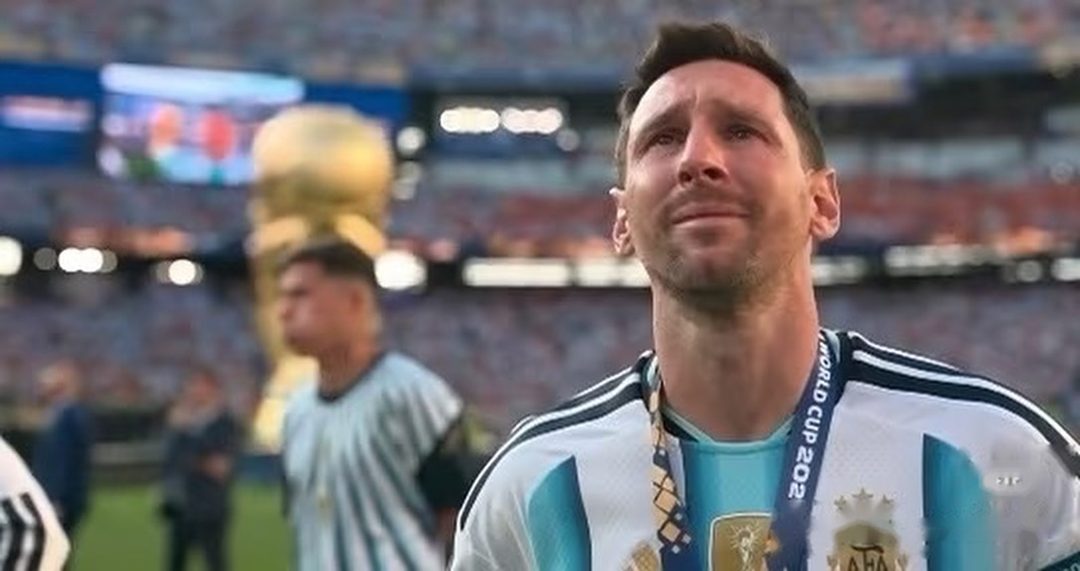
When the final whistle blew, Messi was calm. He shook hands with the Spanish players, quietly watched them celebrate, then sat down on the grass like an ordinary man who had just finished a Sunday kickabout. He collected his runner-up medal, and turned toward the Argentina end — and that was the moment the wall came down.
Tens of thousands of Argentina fans who had refused to leave were chanting the name of a 39-year-old man who had just lost a World Cup final. No boos. No blame. Only songs and applause. Messi stood there, looking up at the stands, and the tears fell one by one.
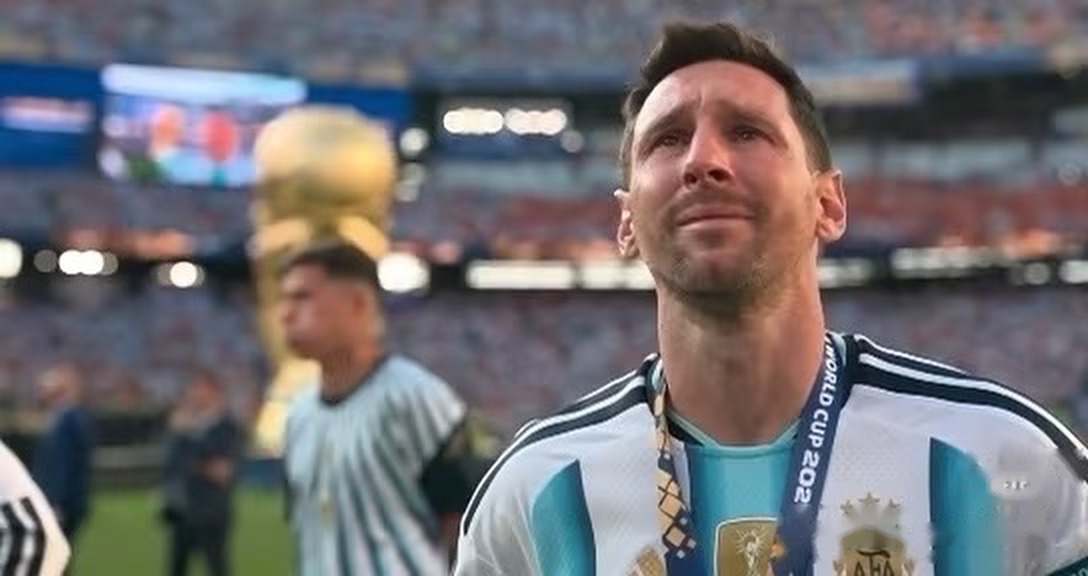
Afterward, he said only one thing: “I feel sad. But I know we played our hearts out.”
Scaloni made it halfway through his press conference before covering his face and walking out, leaving behind the words “it hurts my soul.” The Argentine FA’s official account posted a single line: “Your tears are ours.”
This wasn’t the first time he cried at this World Cup. In the round of 16 against Egypt, Argentina trailed 0-2 until the 79th minute. Messi missed a penalty, then scored the equalizer in the 83rd, and the comeback was completed with a stoppage-time winner: 3-2. At the final whistle he crouched on the pitch, sobbing. When a reporter asked why, his answer has stayed with me since:
✦ Messi on the tears after the Egypt match
“It was a release. I was feeling intense anger because of the penalty I wasted, and because of the way I took it. I felt like in that important moment, I had let the team down. Thankfully, God had something special in store for me in the end.”
And that’s exactly the point I want to make: a man who has played twenty years of elite football and won everything there is to win still burns with fury over one missed penalty, still feels he “let everyone down.” He makes mistakes, he blames himself, he breaks down, he lets it out — he is no different from any of us. The only difference is that when we make our mistakes, forty million people aren’t watching.
He Dragged This Team Here, Stumble After Stumble
The final was lost. But don’t forget how Argentina got to the final. This was not a team that arrived at the finish line in a limousine — it was a team pulled back from the cliff’s edge in match after match. And the hand reaching over the cliff, almost every time, belonged to the 39-year-old.
- Round of 16 vs Egypt: 0-2 down until minute 79. Messi equalized in the 83rd; the winner came in stoppage time. 3-2.
- Semifinal vs England: 0-1 down until minute 85, when Enzo’s thunderbolt leveled it; in the 92nd, Messi’s cross — placed to the centimeter — found Lautaro’s head for the winner.
- The tournament as a whole: 8 goals, second in the scoring chart only to Mbappé’s 10; a career World Cup tally now at 21 goals; and 10 career knockout-stage assists, more than any player in the past 60 years.
Thirty-nine years old. Most players at that age have been retired for five years, sitting in a commentary booth saying “the kids play so fast these days.” He was still beating two men off the dribble at a World Cup, still splitting entire back lines with one pass, still scoring 8 goals in a single tournament. I wrote two articles trying to quantify this with a model, and the correction term the model ended up needing was literally named the “Messi form correction” — even mathematics had to open a dedicated variable for him.
A Human, Not a God: A 15-Year-Old Boy Said It All Long Ago
After watching this final, I want to talk about something that matters more than the result: what kind of eyes should we use to look at a man still standing in a World Cup final at 39? Many people are used to treating him as a god — a god’s goals are taken for granted, and a god’s defeats are treated as sins. But he was never a god.
This question was answered better than anyone could, back in 2016, by a 15-year-old Argentine boy.
That year, Argentina lost the Copa América final to Chile on penalties — a third major final defeat in four years, and Messi had missed his penalty in the shootout. Afterward he told the cameras: “For me, the national team is over. I’ve done all I can.” The whole world waited for him to change his mind, while pundits back home were still calling him soft, still saying he didn’t deserve the blue and white shirt.
A 15-year-old academy kid named Enzo Fernández posted an open letter on Facebook:
✦ Enzo’s letter to Messi (2016)
“How are we going to convince you? In our lives, we have never carried even one percent of the pressure that sits on your shoulders.
You wake up every morning, look in the mirror, and know that more than forty million people not only demand that you do everything perfectly — they believe it is their right to demand it.
How are we going to convince you, when we never stopped to realize: you are a human being. A person with unmatched talent, the best player on the planet — but in the end, a person.
We never understood that the anger losing brings us is not yours to carry; it comes from the frustrations of our own lives. Let’s look in the mirror and ask ourselves: do we demand of ourselves even one percent of what we demand of this boy we don’t even truly know?
Do whatever you want, Lionel. But please, think about staying.
— Thank you, and forgive us.”
You know the rest of the story. Messi stayed. The boy who wrote the letter fought his way into the national team, lifted the World Cup beside Messi in Qatar in 2022, and smashed home the equalizer against England in this tournament’s semifinal. His name is Enzo — and the stoppage-time red card in yesterday’s final was his, too. When football turns cruel, it doesn’t even spare its most tender foreshadowing.
“You have already done your best — and others will always demand you do better.” That is what Messi carried for twenty years. He is not a god. He never was. He is a human who misses penalties, who cries, who says “I let everyone down” — who also happens to be the best footballer this planet has produced. Demanding that a human be a god is the greatest unfairness of all.
Character? Just Look Inside the Dressing Room
To judge a superstar’s character, two places tell you everything: how his teammates treat him, and what his opponents say about him.
The young players of this Argentina squad played football as if Messi were their faith. Enzo wrote him a letter at 15. De Paul spent a decade as his self-appointed bodyguard. Lautaro, Álvarez — the new stars all say the same thing in interviews: to see him lift the trophy once more, we would give everything. The most famous, wealthiest, most senior man in the dressing room having every young player willingly run themselves into the ground for him — skill cannot buy that. Only character can.
What Scaloni said through tears after the final can stand as the closing verdict: “He is the best to ever stand on a pitch.” And the fuller testimony was given long ago, by the people who understand the game best:
- Pep Guardiola: “Don’t write about him, don’t try to describe him. Just watch him.”
- Diego Maradona: “I have seen the player who will inherit my place in Argentine football, and his name is Messi.”
- Jorge Valdano: “Maradona was a miracle. Messi is Maradona every day.”
Years, 6 World Cups. Goodbye.
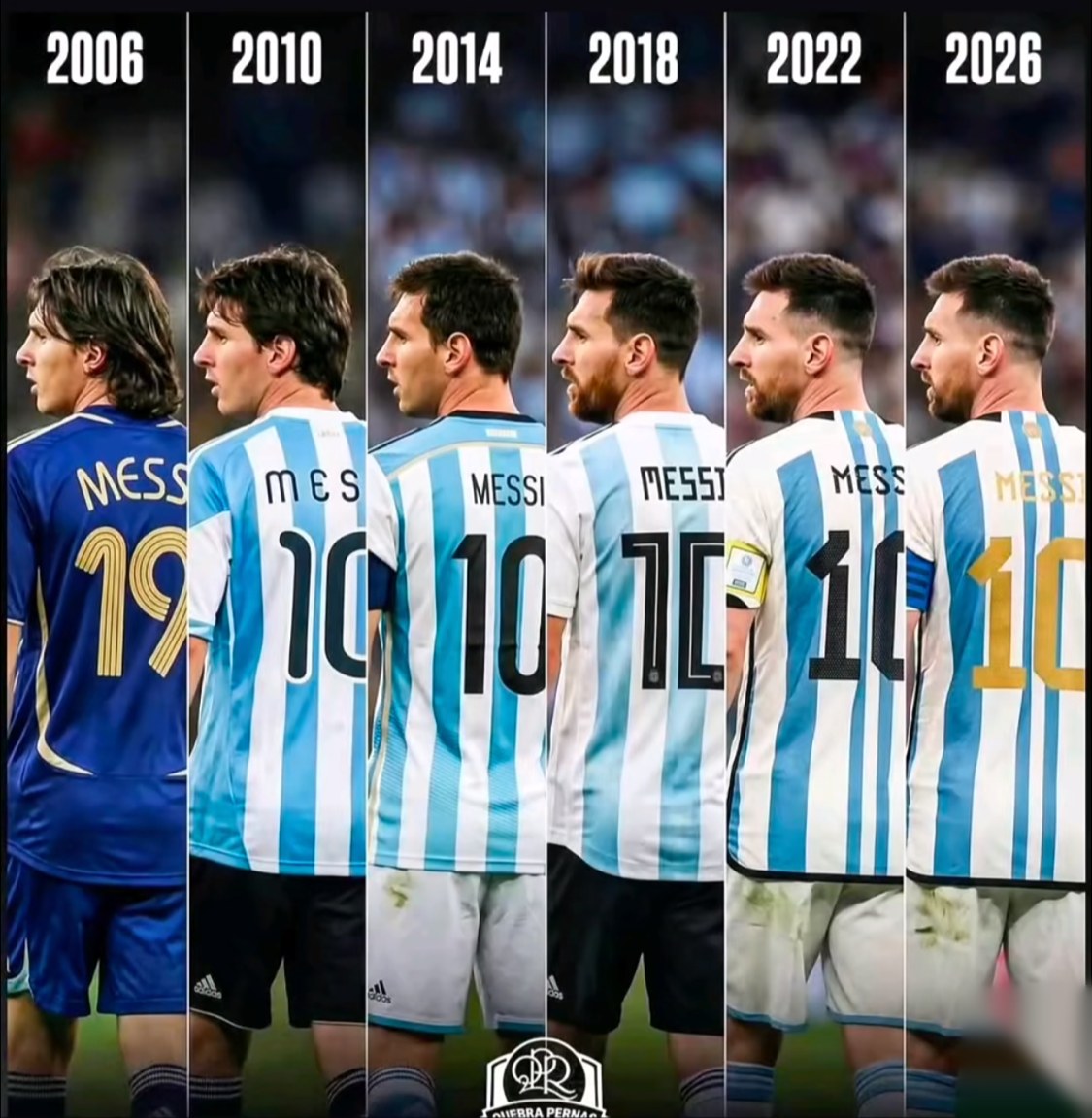
Germany, 2006: a long-haired 19-year-old comes off the bench against Serbia and Montenegro, scores and assists, the youngest goalscorer of that tournament. New Jersey, 2026: a 39-year-old captain stands in the center of the pitch, a runner-up medal on his chest, weeping before the stands.
In between: twenty years, six World Cups. The debut of 2006, the confusion of 2010, the one step short of 2014, the darkest hour of 2018, the fulfillment of 2022, the farewell of 2026. One man’s World Cup chronicle is the chronicle of two generations of fans growing up. We were lucky: at every stage of our lives, we could look up and see the same number 10.
That night in Qatar already paid off the greatest debt, which is why these tears are not as bitter as 2014’s. He lost the final, but he lost nothing — 21 goals across six World Cups, 10 knockout-stage assists that no one in 60 years has matched, a streak of 11 straight World Cup matches with a goal contribution untouched since 1966. And the people singing in the stands proved something better: some things don’t need a trophy to be redeemed.
✦ A final word
This series ran to three articles. fable 5 executed two million simulations and called the champion correctly both times — a remarkable machine. But it was only last night, watching a 39-year-old man cry in front of the stands, that I confirmed the one thing no model will ever compute:
why so many people around the world shed tears for an Argentine’s tears.
Probability governs outcomes. The human heart governs meaning. Thank you, Leo. Thank you for giving the word “love of the game” one concrete shape for twenty years straight.
Disclaimer: This is a fan’s personal essay. Match data comes from public reports, and all quotes are traceable to their original sources — where discrepancies exist, the originals prevail.