On the Eve of the Final, I Had fable 5 Run Another Million Simulations: Messi Kicked More Than Half the Gap Away
All six predictions from the last article hit: Spain 2-0 France, Argentina 2-1 England, and the 41.8%-probability Spain–Argentina final came true. Before the final I fed the semifinal data back to fable 5 and re-ran a million simulations: Spain's win probability dropped from 54.1% to 51.8%, Argentina's rose from 45.9% to 48.2% — Messi, leading the tournament scoring chart, took back the points the model had docked for his age. Plus the story of a photo taken 19 years ago: Messi and baby Yamal.
中文版 / Chinese Version: 决赛前夜,我让 fable 5 又跑了 100 万次模拟:梅西把差距踢没了一半多
Spain vs Argentina · All 6 Predictions From Last Time Hit · The Ultimate Final Simulation
A week ago, when the semifinal bracket was fresh, I wrote I’m a Messi Fan, But I Asked the Strongest Model Ever — fable 5 — to Predict the World Cup. The Answer Hurt. — fable 5 said the most likely final was Spain vs Argentina, with Spain as champion. The semifinals are now done: Spain 2-0 France, Argentina 2-1 England in a comeback — the predicted final is real. Sunday in East Rutherford: the old king against the heir apparent. Before the match, I fed both semifinals’ complete data back to fable 5 and had it recompute the final. This time, the numbers moved.
Grading the Homework: How Did Last Week’s Predictions Do?
Anyone who makes predictions knows the honest reckoning afterward is much harder than the confident forecast beforehand. So let’s pull out the previous article’s core predictions and check them one by one:
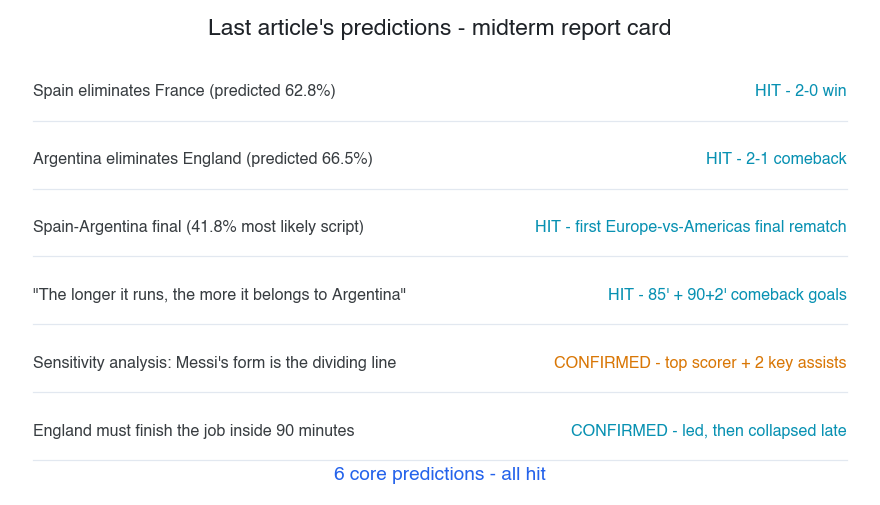
Both semifinal winners called correctly, and the 41.8% most-likely final script came true. The one that gave me goosebumps was the sensitivity analysis — the previous article’s exact words were “Messi’s form is the dividing line for where the trophy goes.” And what happened in the semifinal? A 39-year-old Messi, leading the tournament’s scoring chart, delivered the key pass for Enzo’s 85th-minute equalizer, then in the 92nd minute floated a cross with centimeter-perfect placement onto Lautaro’s head for the winner. ESPN’s post-match rating: 9, best on the pitch. The variable the model circled a week in advance really is deciding matches.
📊 Two fresh historical records, by the way: Messi’s World Cup knockout-stage assist count now stands at 10, six more than any player in the past 60 years; and since 2022 he has contributed a goal or assist in 11 consecutive World Cup matches — nobody has done that since 1966.
What the Model Saw in the Two Semifinals
🇪🇸 Spain 2-0 France: An Execution Without Suspense
The process was crueler than the score. In the 20th minute, Yamal — one day past his 19th birthday — won a penalty in the box, and Oyarzabal converted; in the 58th, Porro and Olmo exchanged a one-two before the finish into the far corner. Mbappé was locked down all night and couldn’t resist criticizing his own team’s “loose” performance afterward. This was Spain’s third consecutive knockout win over France in a major tournament (Euro 2024 semifinal, 2025 Nations League semifinal, and now this) — and their first World Cup final since winning it all in 2010.
But the model also flagged an easily overlooked detail: Spain’s quarterfinal was not comfortable — they needed Merino’s 88th-minute rebound to kill off Belgium, and conceded their first goal of the tournament. This Spain also lets matches drift into deep water; they just happen to score late too.
🇦🇷 Argentina 2-1 England: The Previous Article’s Script, Performed Live
The previous article had one line: “The longer the match runs, the more it belongs to Argentina.” The semifinal followed it beat for beat: Gordon put England ahead in the second half, Tuchel’s side then parked deep, Pickford produced two miracle saves (69th minute off Nico González’s header, 76th off Mac Allister’s shot), and Argentina looked finished — then Enzo’s 20-meter thunderbolt in the 85th, and Messi’s cross for substitute Lautaro’s headed winner in the 92nd.
Here’s the fact that had to go into the model: counting the stoppage-time winner against Egypt in the round of 16, Argentina became the first team in World Cup history to score two second-half stoppage-time winning goals in a single tournament. That’s no longer the abstract “kings of the knockouts” label — that’s quantifiable late-game dominance.
The Model Update: Three Parameters Moved
fable 5 didn’t tear up its framework. Like a good Bayesian, it updated old beliefs with new evidence. Three changes:
- Elo settlement: booking the real knockout results at World Cup weight (K=50, goal-difference bonus). Spain’s two wins lift them to 2243; Argentina rises to 2183. The gap goes from 57 to 60 points — wait, it widened? Yes: Spain beat France, a higher-value win. What actually closes the gap is the next item.
- Messi form correction, +12: in last week’s −22 age penalty, Messi’s decline was the largest weighted term. But leading the scoring chart, 11 straight games with a goal contribution, two assists in the semifinal — the evidence says that penalty hit the wrong target. The model returns Messi’s share of the deduction (the back line’s age penalty stays; Otamendi is still 38). Argentina climbs to 2195; final gap: 47 points.
- A new “clutch gene” variable: two stoppage-time winners in one tournament is hard data. The model grants Argentina a 56:44 late-game tilt in scripts still level after minute 85. Spain’s own 88th-minute winner against Belgium is also booked, so the tilt is less lopsided than you’d imagine — both teams can kill in deep water.
The New Million Simulations: 48.2 vs 51.8
Parameters updated, one million final simulations re-run. First, this chart — the real trajectory of the scales over the past week:
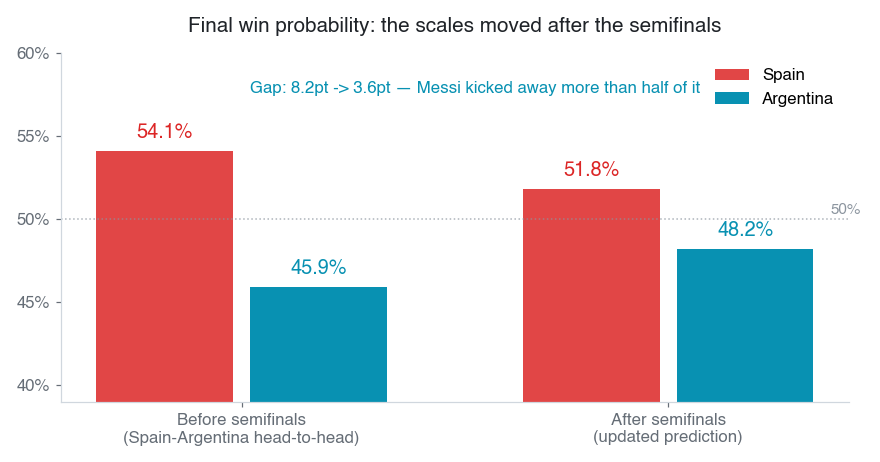
A week ago the model gave the Spain–Argentina final 54.1 : 45.9 — an 8.2-point gap. After two semifinals, it’s 51.8 : 48.2 — just 3.6 points. Spain beat France 2-0, gained Elo — and the gap still got cut by more than half. Cut by whom? By the 39-year-old, who used a tournament-leading scoring run to physically wrestle back the points the model had docked him.
Even more interesting is the decomposition of championship paths. fable 5 split the million finals by how they were won:
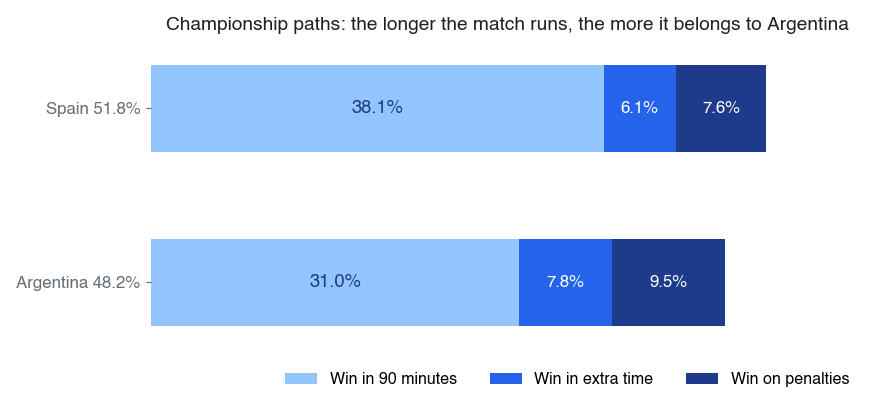
The pattern jumps out: within 90 minutes, Spain clearly leads 38.1% to 31.0%; but once the match reaches extra time (7.8 vs 6.1) or penalties (9.5 vs 7.6), both paths flip to Argentina. The model puts extra time at 31% probability and a shootout at 17.1% — and of all Argentina’s championship scripts, more than a third happen after the 90th minute.
⚠️ So the final comes down to one sentence: Spain must kill the match inside 90 minutes; if it’s still alive at minute 91, the scales tip to Argentina — where the clutch gene lives, where Emiliano Martínez lives, where a team that hasn’t lost in deep water since 2022 lives. Tuchel’s England already validated this law with their elimination.
The Final Prediction — and a Story From 19 Years Ago
✦ fable 5’s Ultimate Final Prediction
🏆 Champion: Spain, 51.8% — but this is the least confident of fable 5’s two predictions
🇦🇷 Argentina: 48.2% — up from 45.9% in one week; all momentum on this side
⏱️ 31% probability of extra time, 17.1% of penalties
🎯 The decider: whether the match survives into minute 91
📉 A 3.6-point gap = one refereeing call, one shot off the post, one Messi moment
The bookmakers also list Spain as the favorite, consistent with the model. But as a fan, I want to close with a story beyond the data — because the bond between the two teams’ talismans was written 19 years ago.
Barcelona, 2007. A charity event organized by Catalan media: a calendar shoot pairing Barça players with local newborns. A five-month-old baby was carried into the studio, and the person assigned to bathe him was a 20-year-old, long-haired Argentine who had just established himself at Camp Nou — Lionel Messi.

The baby lying in the blue basin was named Lamine Yamal.
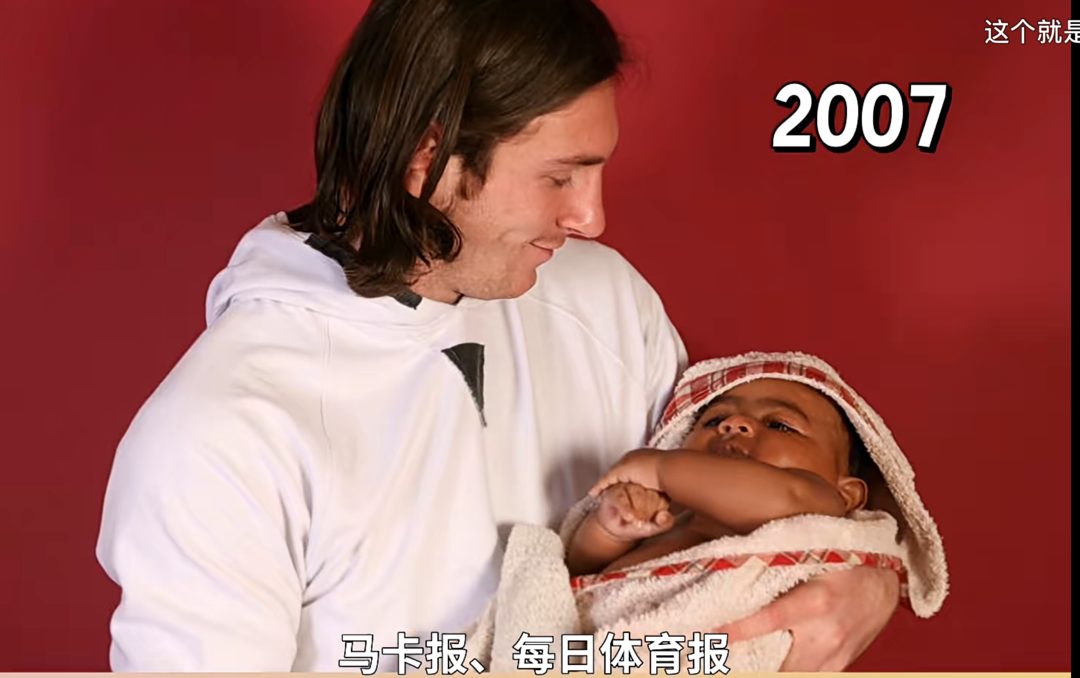
The photo slept for over a decade until Yamal exploded onto the scene at Barça, and then it went around the world overnight. Yamal grew up idolizing Messi — wears number 10, plays off the left foot, came up through La Masia — his entire trajectory retracing the man who once held him as an infant. During this World Cup, a journalist handed him the photo in an interview, and the 19-year-old doubled over laughing:
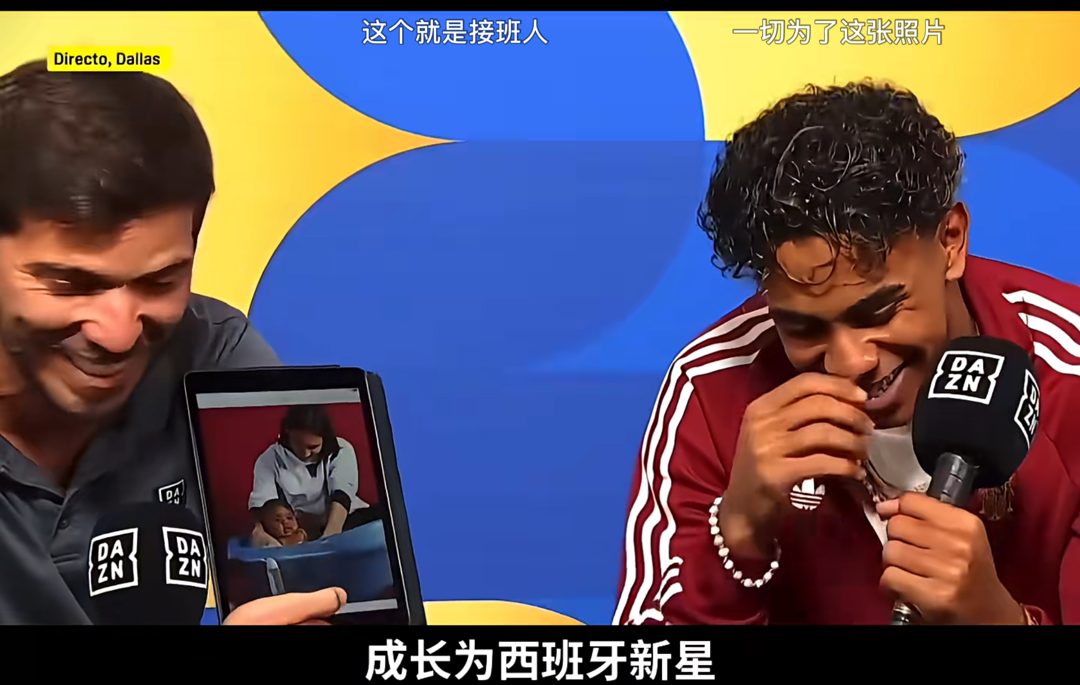
The man who bathed him 19 years ago now stands across from him in a World Cup final. When fate writes a script, even its foreshadowing is more disciplined than any human screenwriter’s.
If Argentina wins, they become the third team ever to retain the World Cup, after Italy (1934/38) and Brazil (1958/62) — Messi’s second trophy at 39 years and 24 days. If Spain wins, football formally enters the Yamal era. Either way, what we’re watching on Sunday night isn’t a football match — it’s a live broadcast of a generational handover.
✦ 48.2% is the most beautiful probability this fan has ever seen. A week ago the model’s script for Messi read “miracle required.” A week later, Messi used two assists to rewrite “miracle” into “nearly a coin flip.” The remaining 3.6 points are left to Sunday night in East Rutherford. Vamos Argentina — this time, even the math is starting to soften.
Disclaimer: This article is a probabilistic exercise by an AI model based on public data. Parameter choices involve subjective assumptions. For fan entertainment and discussion only — not betting advice.